
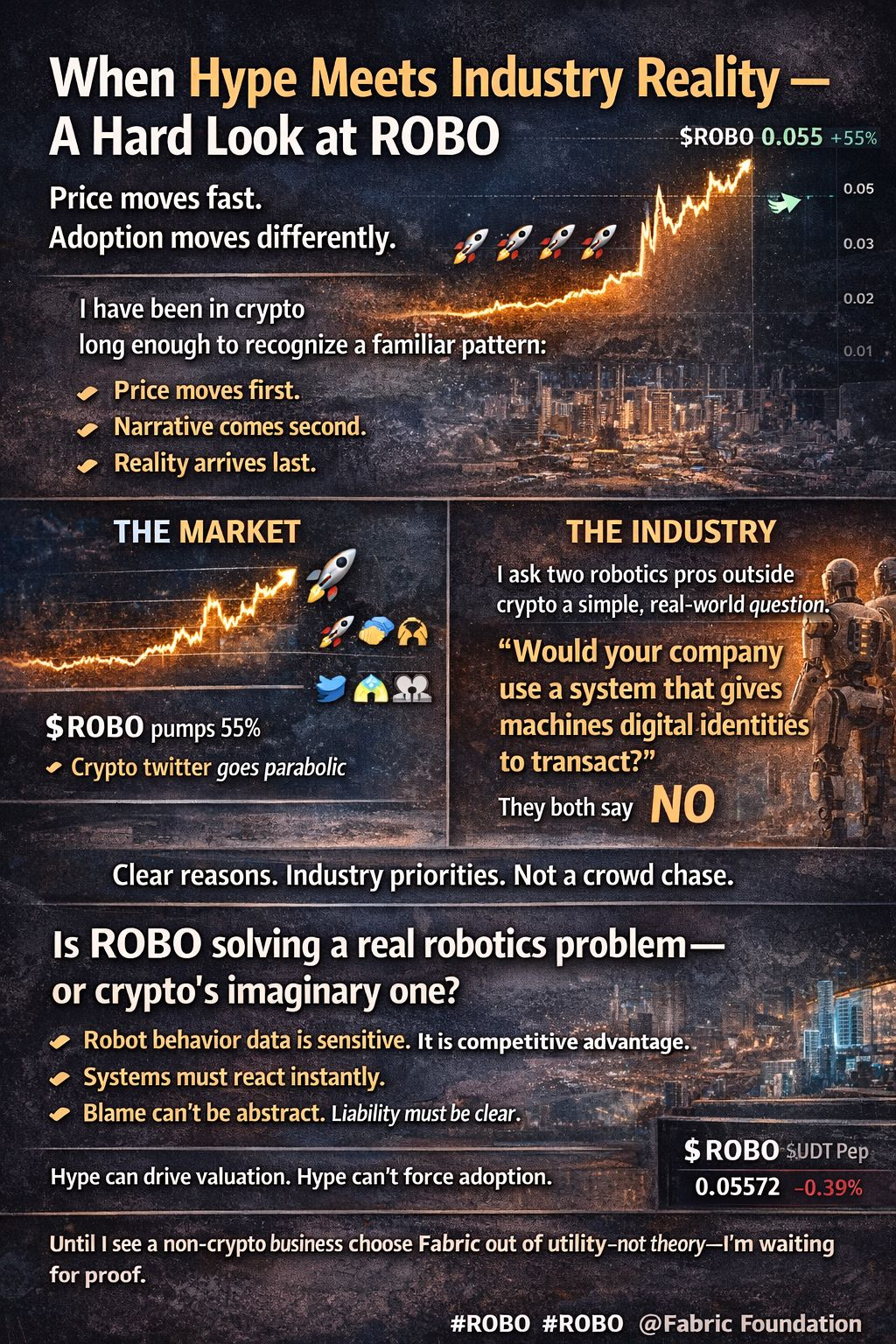
Price moves first.
Narrative comes second.
Reality arrives last.
When $ROBO pumped hard and timelines filled with rocket emojis and conviction threads about the machine economy:
I stepped away from the charts.
And I asked a simple question outside the crypto bubble.
Not on X.
Not in Telegram.
Not on Binance Square.
In the real world.
I spoke with two people who actually work with robotics. One in industrial automation. One in service robotics. I avoided words like “token,” “staking,” or “decentralized protocol.”
I asked them this:
If there were a system that gave machines their own digital identities and allowed them to transact independently, would your company use it?
Both answers were immediate.
No.
Not “maybe later.”
Not “if regulation changes.”
Just no.
The reasons were practical.
• Robot behavior data is sensitive. It is competitive advantage.
• Latency matters. Systems must react instantly.
• Liability must be clear. If a robot causes harm, responsibility cannot be abstract.
In theory, decentralization sounds resilient.
In practice, companies need someone accountable.
When something breaks, insurance companies don’t accept “the network decided.”
They want a name.
This doesn’t prove Fabric is wrong.
But it raises a harder question:
Is ROBO solving a problem the robotics industry actually has — or a problem crypto imagines it has?
Crypto is excellent at solving its own internal pain points.
DeFi fixed DeFi friction.
NFT tools fixed NFT creator problems.
Wallet UX improved because crypto users demanded it.
Those were native problems.
Industrial robotics is different. It already has identity systems. Serial numbers. Access logs. Regulatory frameworks. Insurance recognition. Imperfect — but functional.
To justify itself, Fabric doesn’t just need a compelling vision.
It needs a real-world use case where a robotics company says:
“This system is better than what we already use.”
Right now, I haven’t seen that proof.
This is where markets and reality diverge.
A token price can rise dramatically on belief alone.
Narratives can sustain valuation for years.
But belief is not adoption.
And valuation built on expectation assumes that future demand is inevitable.
The current price of ROBO reflects confidence that:
Machines will need decentralized identity.
Blockchain is the optimal solution.
Fabric will win that race.
That is a three-layer bet.
It might work.
Infrastructure bets sometimes do.
But they require patience, discipline, and a clear invalidation point.
The dangerous move is simpler:
Buy because it’s pumping.
Hold because the story feels intelligent.
Exit only after the narrative collapses.
By then, early buyers have already rotated out.
What real-world problem, experienced today by non-crypto participants, does this solve?
For ROBO, I don’t yet have a clean answer.
That does not mean it will fail.
It means I am not comfortable paying today’s certainty for tomorrow’s possibility.
Waiting for evidence is not pessimism.
It is risk management.
