
The crypto market is full of noise, hype, and short-lived trends — but every once in a while, a project appears that focuses more on structure than speculation. @Fabric Foundation Fabric Foundation Coin (FBC) is positioning itself as exactly that: a utility-driven digital asset built around long-term infrastructure rather than short-term excitement.
From a fundamental perspective, Fabric Foundation Coin is designed to serve as the backbone of its ecosystem. Instead of being just another tradable token, FBC aims to power transactions, governance, and ecosystem participation. The core vision behind the project is sustainability and scalability. Many blockchain projects struggle with congestion, high transaction fees, and lack of real-world use cases. Fabric Foundation is attempting to address these problems by building a streamlined framework that focuses on efficiency and practical integration.
One of the key strengths of FBC lies in its token utility. A coin with real demand usually has three pillars: usability, scarcity, and ecosystem expansion. If FBC is integrated into staking mechanisms, governance voting, platform services, or developer incentives, it creates organic demand rather than artificial hype. Long-term value in crypto rarely comes from marketing alone — it comes from adoption. If the Fabric ecosystem continues to grow partnerships, applications, and user participation, the underlying token could benefit from increased transactional activity.
Tokenomics also plays an important role. A balanced supply model — whether deflationary through burns or controlled through limited issuance — can support price stability over time. Investors should always look at circulating supply, total supply, vesting schedules, and whale concentration. A healthy distribution reduces manipulation risk and builds confidence among retail participants.
From a technical analysis perspective, FBC’s price behavior would likely follow classic crypto market cycles: accumulation, expansion, distribution, and correction. During accumulation phases, price moves sideways while stronger hands quietly build positions. Breakouts above resistance zones often signal momentum expansion. Volume confirmation is critical here — a breakout without volume is usually weak.
Support and resistance levels are essential for short-term traders. Key moving averages such as the 50-day and 200-day can help identify trend direction. If price holds above major moving averages, it often indicates bullish structure. Conversely, repeated rejection from resistance combined with declining volume may signal weakness.
Momentum indicators like RSI can also help determine whether the asset is overbought or oversold. However, fundamentals should always align with technical strength. A coin with strong charts but weak fundamentals usually fades. A coin with strong fundamentals and improving technical structure often has better long-term potential.
That said, risk management is crucial. Cryptocurrency remains highly volatile, and newer foundation-based coins can experience sharp price swings. No matter how strong a project appears, investors should avoid overexposure and always diversify.
In summary, #FabricFoundation ROBO Binanc 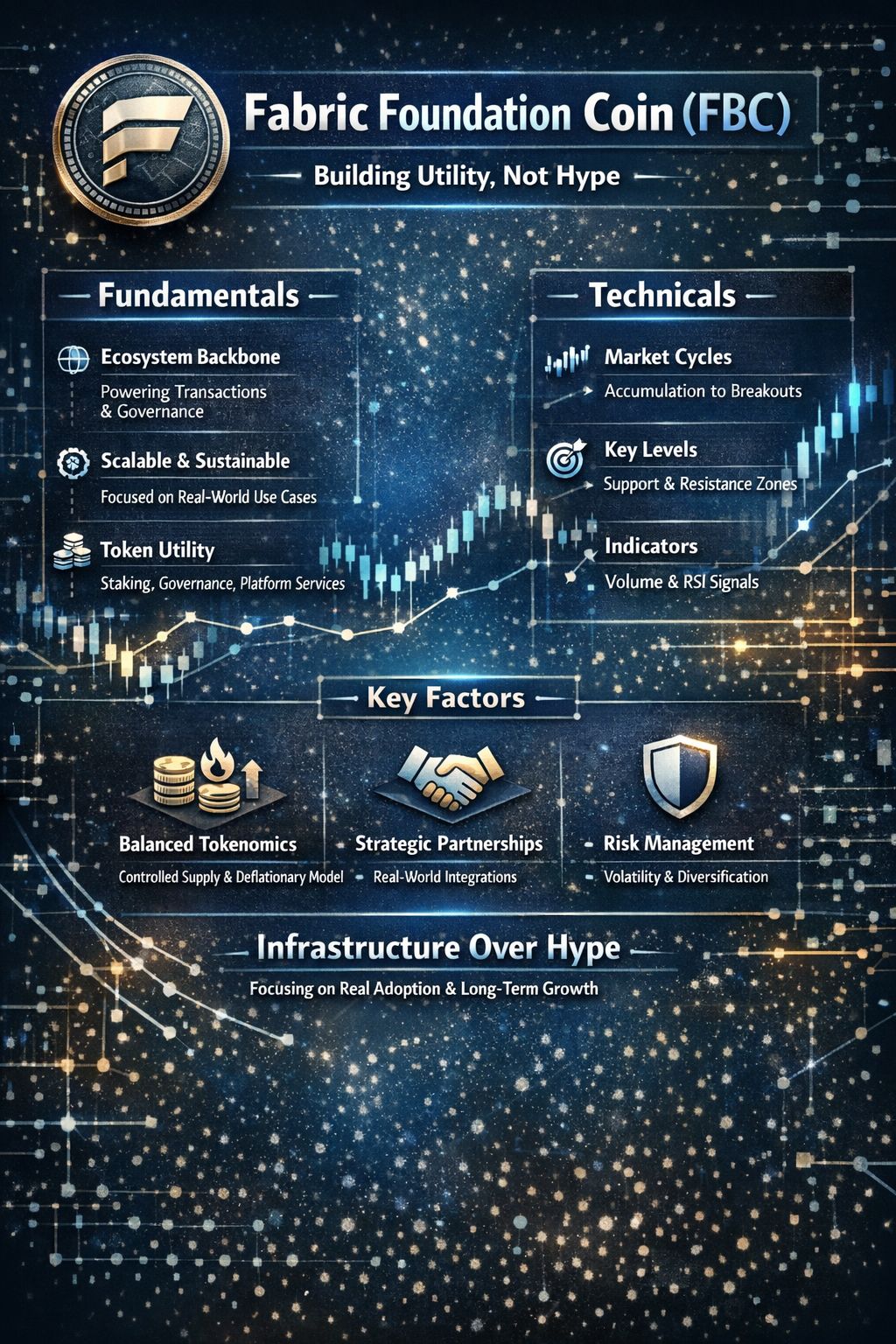 Fabric Foundation Coin represents a project aiming to build infrastructure rather than hype. Its long-term success will depend on real ecosystem growth, transparent development, strategic partnerships, and consistent user adoption. Technically, traders can watch key levels and momentum shifts, while fundamentally, the real story will unfold through adoption and utility expansion.
In crypto, foundations matter. And if Fabric truly lives up to its name, it may aim to weave a durable structure in an ever-changing digital economy.$ROBO
