#robo $ROBO Let’s talk about something most people still aren’t paying attention to.
While everyone’s arguing about AI chatbots and memecoins, there’s a much bigger shift happening in the background. Machines are getting smarter. Robots are moving from factories into streets, warehouses, hospitals, even homes. The real question isn’t whether they’ll be part of the economy. It’s who controls that economy.
That’s where Fabric Foundation steps in.
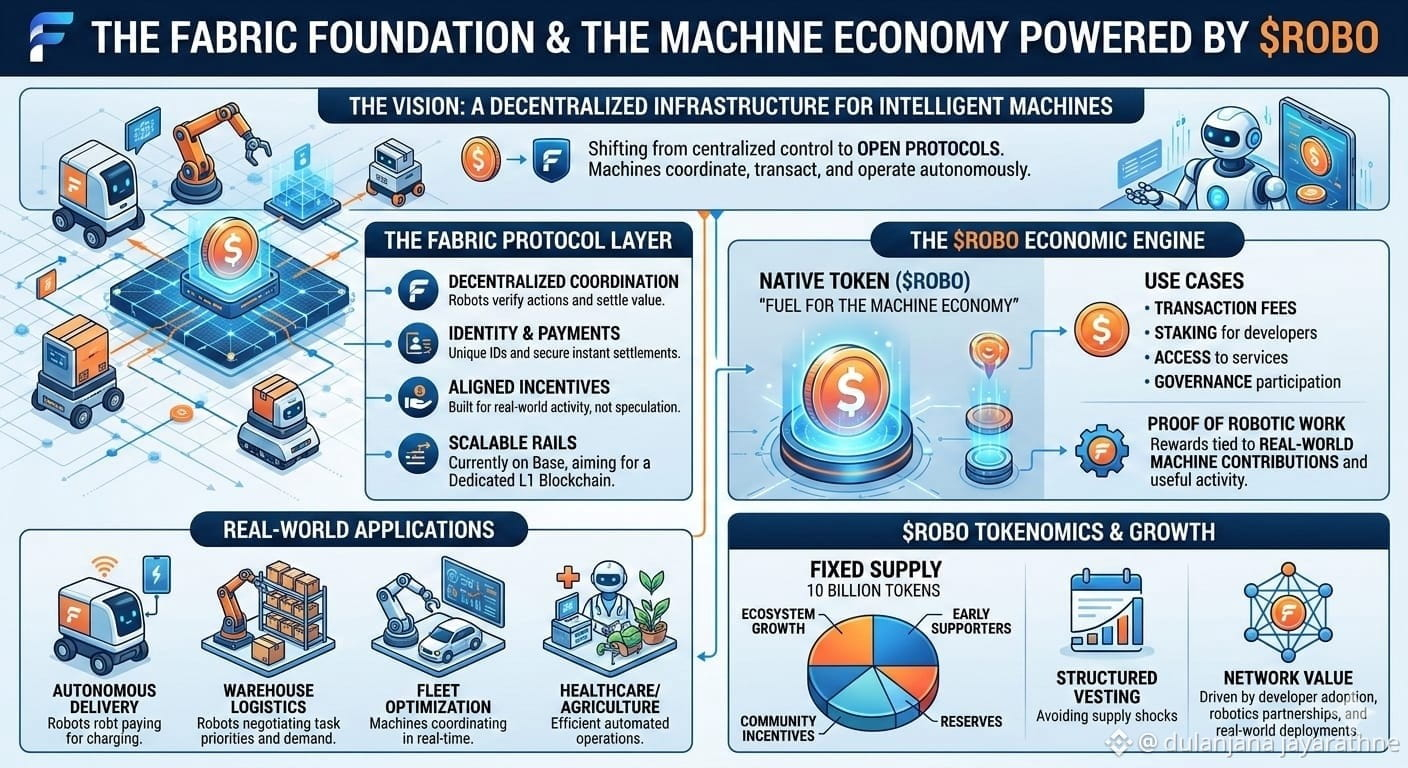
Fabric isn’t trying to build another flashy AI app. They’re building infrastructure. The kind of rails that intelligent machines can actually run on. A decentralized protocol where robots and autonomous systems can coordinate, transact, and operate using aligned incentives. And the fuel behind all of that is $ROBO.
The idea is simple but powerful. If machines are going to work together at scale, they need identity. They need payments. They need a way to verify actions and settle value without relying on a centralized company controlling everything. Fabric is building that layer.
Right now, the protocol is live on Base, which gives them speed and lower fees. But the long-term vision is much bigger. They’re aiming to launch their own Layer 1 blockchain designed specifically for machine-to-machine interaction. Not humans trading JPEGs. Machines coordinating real-world activity.
Think about that for a second.
Imagine a delivery robot that can autonomously pay for charging. Or a warehouse robot that negotiates task priorities with another system based on demand. Or fleets of machines optimizing logistics in real time, settling payments instantly without a bank in the middle. That’s the type of coordination Fabric is building toward.
Now let’s talk about $ROBO.
This isn’t just a random governance token thrown into the mix. $ROBO is the economic engine of the network. It’s used for transaction fees, staking, access to services, and governance participation. Developers who want to build on Fabric stake $ROBO. Participants use it to interact with the protocol. Rewards are distributed based on actual robotic activity through something they call Proof of Robotic Work.
That part matters.
Instead of rewarding pure speculation, the system is designed to tie incentives to real-world machine contributions. If robots are doing useful work, value flows through the network. That’s a completely different mindset compared to most crypto projects chasing hype cycles.
The Fabric Foundation itself operates as a non-profit focused on open infrastructure. The team brings experience from robotics, blockchain, and decentralized governance. They’re not positioning this as a quick flip. The narrative is long-term. Infrastructure-level. Almost boring on the surface, but extremely powerful if it works.
Tokenomics-wise, $ROBO has a fixed supply of 10 billion tokens. Allocations are spread across ecosystem growth, early supporters, community incentives, and long-term reserves. Vesting schedules are structured to avoid immediate supply shocks. Of course, like any token, market dynamics will always play a role. But at least the design isn’t chaotic.
Since launch, ROBO has seen strong exchange support and early trading activity. Visibility helps. Liquidity helps. But what really matters is whether developers and robotics companies actually build on top of it. That’s the real test.
And this is where things get interesting.
We’re moving into a world where automation isn’t optional. Logistics, manufacturing, agriculture, even healthcare machines are taking on bigger roles every year. If those systems stay fully centralized, a handful of corporations will own the machine economy.
Fabric is betting on a different outcome.
They’re building the coordination layer so that intelligent machines can operate in an open network instead of a walled garden. If that vision plays out, ROBO doesn’t just become another token. It becomes the settlement asset for machine-to-machine economic activity.
Is that ambitious? Absolutely.
Is it guaranteed? Of course not.
But this is the kind of asymmetric idea crypto was meant for. Not just faster payments or speculative cycles, but entirely new economic layers that didn’t exist before.
We’re still early in this story. The roadmap includes deeper integrations, ecosystem expansion, and eventually transitioning toward their own chain purpose-built for robotic coordination. Execution will be everything. Partnerships will matter. Real-world deployments will matter even more.
What I like about Fabric is that it’s not chasing noise. It’s positioning for a future that feels inevitable. Intelligent machines are coming. The only question is whether they coordinate through closed systems or open protocols.
Fabric is betting on open.
And if they pull it off, the machine economy won’t just belong to tech giants. It’ll run on decentralized rails powered by $ROBO.