

ROBOUSDT is trading around 0.04901, down 17.45%. The market is clearly volatile. But price movement and long-term infrastructure are two very different conversations. When we step away from the red candles and look at the December 2025 whitepaper, Fabric Protocol presents something much larger than short-term trading action. It proposes a decentralized coordination layer for robots and AI systems with ROBO at the center of that machine economy.
This is not just another AI token narrative. Fabric is attempting to design infrastructure for autonomous machines, similar to how blockchains coordinate financial systems today.
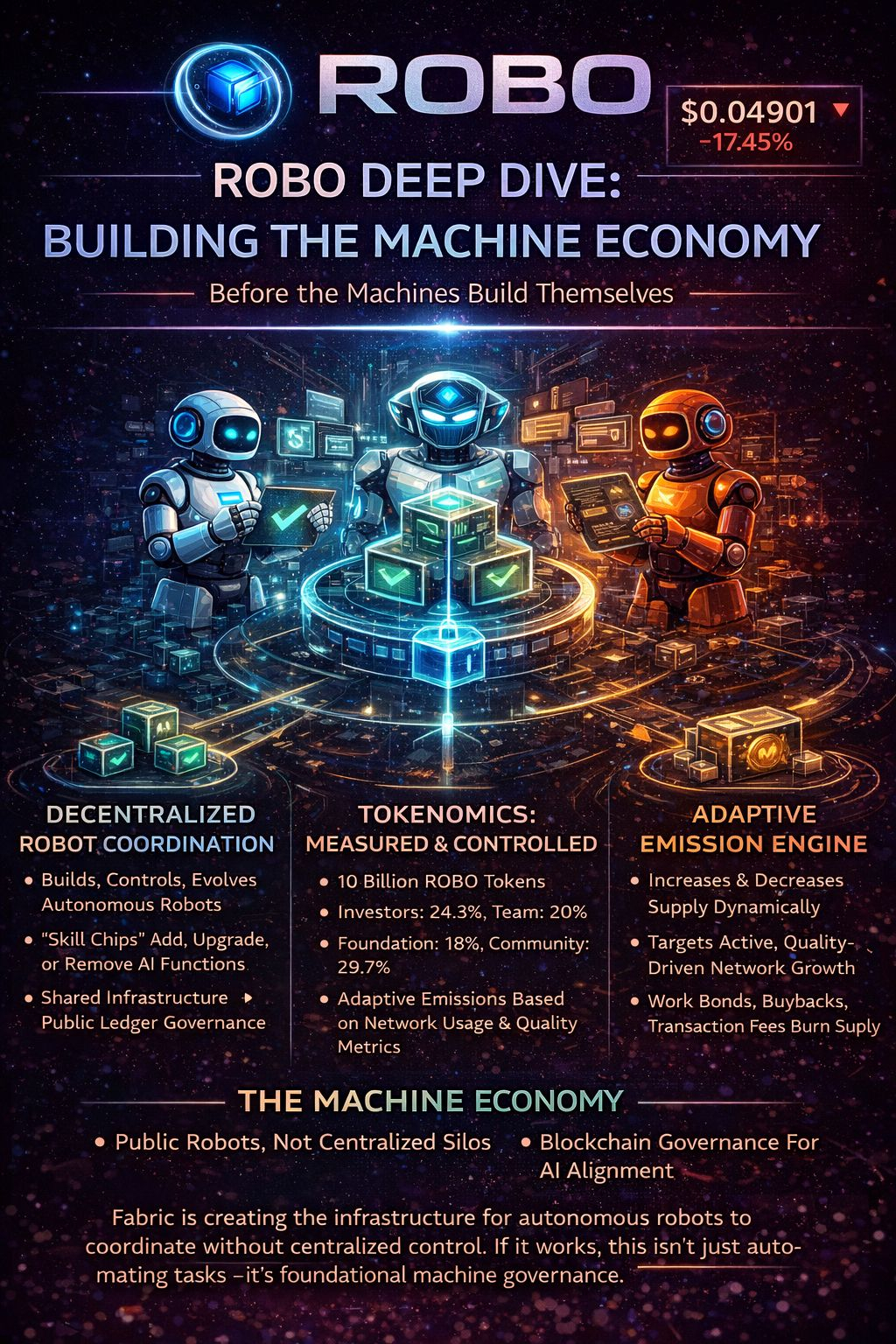
The Core Idea: Decentralizing Robot Intelligence
At its foundation, Fabric Protocol introduces a decentralized framework for building and evolving ROBO1, a general-purpose robot. Unlike centralized AI systems where data, control, and governance are opaque and privately owned, Fabric moves coordination onto a public ledger.
The vision is simple but radical: robots should not be controlled by a single corporation. Instead, computation, ownership, governance, and oversight should be distributed.
ROBO1 is described as modular. Its AI “brain” consists of multiple functional components. Skills can be installed or removed through “skill chips,” functioning similarly to app installations in a mobile app store. Contributors who train models, improve safety mechanisms, or enhance performance are rewarded economically. Users pay fees to access robotic services.
The ambition is not just to create smarter robots. It is to make robots public infrastructure collectively owned, transparent, and economically aligned with humans.
Project Objectives: Balancing Automation and Alignment
Fabric outlines three main goals:
1. Build a global open network for developing general-purpose robots.
2. Mitigate job displacement and centralization risks.
3. Ensure long-term human–machine alignment.
The automation conversation often centers on efficiency but ignores ownership concentration. Fabric attempts to address that by promoting shared robotic skills, lowering service costs, and enabling workforce reskilling through open participation.
The protocol frames itself as an alignment-first system. Instead of “winner-takes-all” AI dominance, it proposes distributed governance, public auditability, and shared incentives. Whether this can compete with centralized capital-backed AI labs remains an open question, but the philosophical positioning is clear.
Technical Architecture: Machines Coordinating Machines
ROBO1 supports multiple physical embodiments humanoid, wheeled, quadruped making the architecture hardware-agnostic. Integration is managed via drivers such as OM1, enabling flexible deployment.
The protocol integrates several standards:
ERC-7777 for identity
ERC-8004 for governance
Decentralized VPNs (dVPNs) for coordination
Trusted Execution Environments (TEE) for secure identity verification
What stands out most is the dedicated Layer 1 blockchain designed specifically for non-biological machine coordination. Unlike traditional blockchains optimized for financial transactions, this Layer 1 prioritizes autonomous interaction between machines.
Development unfolds across three phases:
Phase 1 focuses on prototyping using existing hardware and alignment research.
Phase 2 expands open-source contributions and introduces revenue-sharing mechanisms.
Phase 3 launches the dedicated machine-native mainnet.
If executed successfully, Fabric becomes less of a robotics project and more of an operating system for autonomous agents.
Tokenomics: Structured, Controlled, and Utility-Focused
ROBO has a fixed total supply of 10 billion tokens. Allocation is distributed as follows:
Investors: 24.3% (12-month cliff + 36-month vesting)
Team & Advisors: 20%
Foundation Reserve: 18%
Ecosystem & Community: 29.7%
Airdrop: 5%
Liquidity & Public Sale: 3%
ROBO is explicitly defined as a utility token. It does not grant equity, dividends, or ownership rights. It launches initially as an ERC-20 token on Ethereum, with potential migration to Fabric’s native Layer 1.
Utility includes:
Network fees
Staking
Governance participation
Bonding mechanisms
The structured vesting schedule reduces immediate supply shock, but long-term value depends entirely on adoption.
Adaptive Emission Engine: Algorithmic Monetary Policy
One of the most sophisticated elements of the whitepaper is the Adaptive Emission Engine.
Token issuance adjusts dynamically based on network usage (Uₜ) and quality metrics (Qₜ). Emissions are increased or reduced depending on whether the network exceeds or underperforms target metrics. Issuance is bounded within predefined limits to prevent instability.
This introduces a feedback-driven economic system rather than a fixed emission schedule.
Additional demand sinks include:
Work bonds
Transaction fees
Revenue-based buybacks
Circulating supply is mathematically determined by factoring in locked tokens, bonded collateral, emissions, and burns.
This is not a meme economy. It is a model-driven machine economy attempting to self-regulate through measurable activity.
Governance: veROBO and Long-Term Commitment
Governance operates through veROBO. Users lock tokens to obtain voting power, with influence increasing alongside lock duration.
Voting decisions include:
Emission targets
Quality thresholds
Slashing parameters
However, governance does not directly control treasury funds. Authority remains limited to protocol-level mechanics.
Open questions remain regarding validator distribution, sub-economy fragmentation, and resistance to governance gaming. The system appears theoretically sound but will require real-world stress testing.
Roadmap: 2026 Execution Year
The 2026 roadmap is structured as follows:
Q1: Robot identity system and task payments
Q2: Marketplace expansion for tasks and data
Q3: Complex task execution and large-scale coordination
Q4: Reliability improvements
Post-2026 focuses on launching the machine-native Layer 1 and autonomous coordination at scale.
The sequencing suggests Fabric understands that identity and payments must come before large-scale machine collaboration.
Legal and Technical Risks
Legally, ROBO is positioned as non-security under U.S. law. However, regulatory shifts remain unpredictable. Participants bear responsibility for compliance, taxes, and sanctions exposure.
Technical risks include:
Software exploits
Network failures
Sybil attacks
Task integrity limitations
Slashing penalties range from 5% to 50% of bonded collateral, indicating strong deterrence mechanisms. Still, no distributed system is immune to edge-case exploits.
Cold-start risk is perhaps the largest challenge. A machine economy requires machines actively transacting. Without early hardware adoption and meaningful use cases, even the most elegant economic model remains theoretical.
Additional Vision: Beyond Transactions
Fabric’s broader ambition extends beyond payments.
It proposes:
A Global Robot Observatory for oversight
A decentralized skill marketplace
Non-discriminatory payment systems
Revenue sharing
Markets for power, data, compute, and skills
If successful, this would shift robotics from proprietary vertical silos into interoperable public infrastructure.
That is an enormous leap from robotic services to robotic civilization layers.
Overall Evaluation: Ambitious, Mathematical, Unproven
Fabric Protocol outlines one of the most structurally detailed robot-economy frameworks to date. The adaptive emission model and anti-Sybil reward distribution demonstrate serious economic engineering.
Strengths:
Transparent design
Shared ownership model
Strong utility definition
Alignment-focused architecture
Weaknesses:
Regulatory uncertainty
Hardware integration complexity
Adoption dependency
Token value erosion risk if usage stagnates
The whitepaper reads more like a systems design blueprint than a marketing document. That is both impressive and intimidating.
The current -17.45% market move reflects volatility, not necessarily viability. But volatility cuts both ways. The real test is whether Fabric can move from theory to measurable machine coordination.
If it succeeds, it could redefine how robots interact, transact, and align with humans.
If adoption fails, it risks becoming another ambitious protocol without sustained network activity.
In the end, Fabric is attempting something fundamental: to create infrastructure where machines coordinate autonomously, yet remain economically and ethically aligned with humanity.
That is not a small experiment.
And in markets where narratives move fast, execution will matter far more than speculation.