

When I first hear the words “Fabric Protocol,” it sounds technical and complex. But when I slow down and really look at it, I am seeing something much more human. I am seeing people trying to build a system where robots can work with us safely, openly, and honestly. I am not just watching machines get smarter. I am watching them grow up inside a structured, shared environment where everything they do can be checked and understood.
Fabric Protocol is basically a global open network. That means I am not looking at one private company controlling everything. I am seeing a public system that anyone can join and build on. It is supported by a non-profit group called the Fabric Foundation. So I am not dealing with a secret organization trying to own all the robots. I am seeing a foundation that is focused on building shared infrastructure for everyone.
Now let me explain it in simple terms.
When I think about robots in the real world, I am imagining machines that clean floors, deliver packages, assist in hospitals, inspect factories, or even help at home. These robots are not just toys. They are doing real tasks. And when I am letting a robot do something important, I am asking questions. Who programmed it? Who controls it? How do I know it is following the rules? What happens if it makes a mistake?
Fabric Protocol is working on answering those questions.
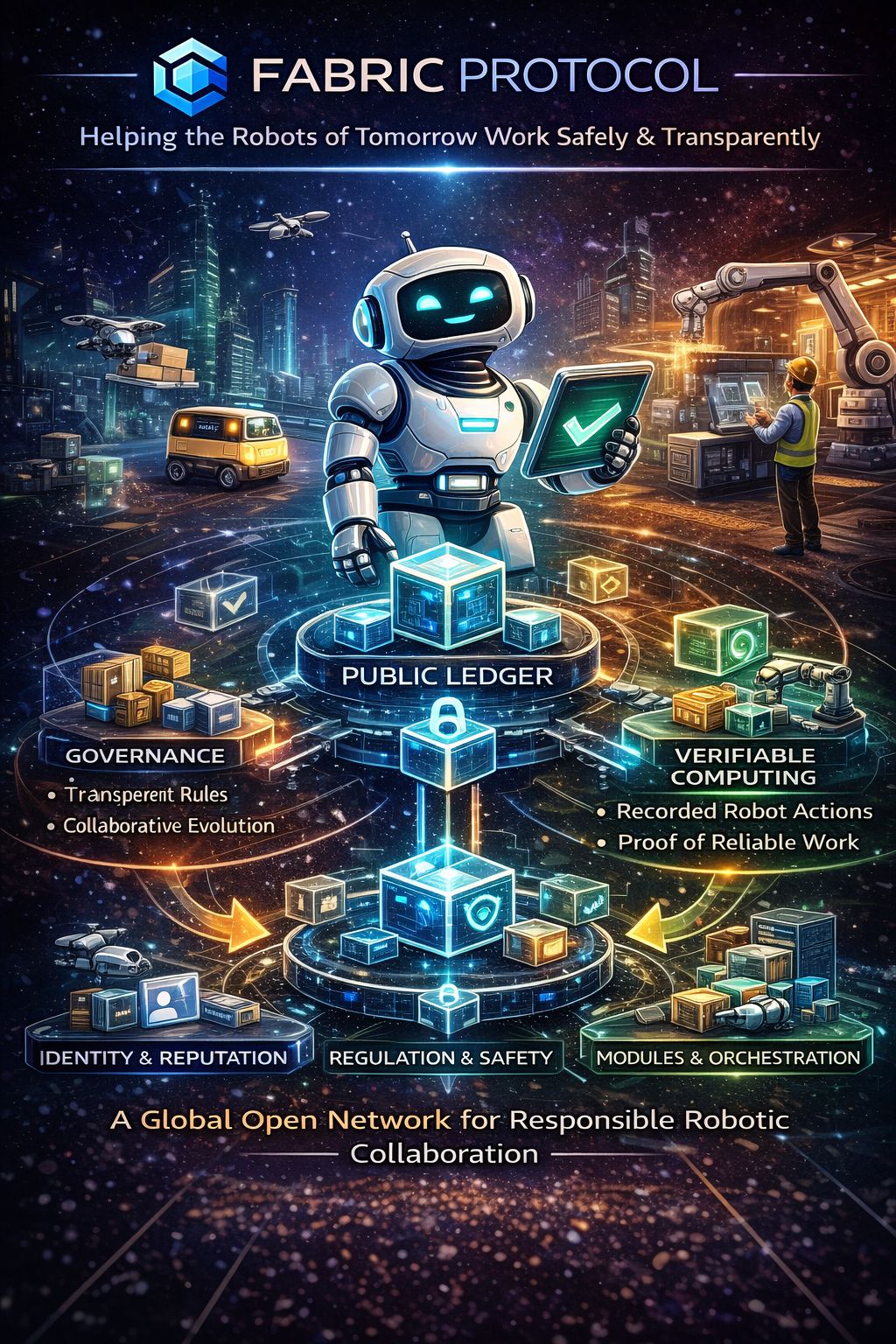
I am seeing Fabric as a kind of shared digital backbone for robots. Instead of each robot living in its own isolated system, I am watching them connect to a common network. This network records what they are doing, how they are making decisions, and how they are improving over time. Everything important can be logged in a public ledger. A public ledger is like a shared digital notebook that many people can see and verify.
So when I am watching a robot perform a task, I am not just trusting it blindly. I am knowing that its actions and computations can be verified. That is what “verifiable computing” means in everyday language. It means I am not just hearing, “Trust me.” I am seeing proof that the robot actually did what it claimed to do.
Fabric is also described as “agent-native infrastructure.” That might sound complicated, but I like to think of it this way: the system is built especially for intelligent agents, like robots or AI systems. I am not forcing robots into old internet systems that were designed for humans typing on keyboards. I am building infrastructure that understands robots are acting, sensing, moving, and making decisions on their own.
What I find interesting is how Fabric helps robots evolve together. I am not just seeing one robot improve alone. I am watching a collaborative evolution. If one robot learns something useful like a better way to grip an object or navigate a hallway that knowledge can be shared across the network. Other robots can benefit from that improvement.
It feels like I am watching a community of robots grow smarter together instead of competing in silence.
Governance is another important part. When I hear “governance,” I am thinking about rules. Who sets the rules? Who updates them? Who makes sure they are fair? Fabric Protocol includes ways for the community to participate in these decisions. I am not just relying on one central authority to decide how robots should behave. I am seeing a shared governance model where updates and changes can be proposed, reviewed, and agreed upon.
This matters because robots are entering real human spaces. If a delivery robot is moving through a city, I am wanting it to follow local laws and safety standards. If a robotic assistant is working in a hospital, I am expecting it to respect privacy and medical regulations. Fabric helps coordinate these rules through the public ledger, so compliance is not hidden or random. I am watching regulation become part of the system itself.
The protocol also coordinates data and computation. In simple terms, I am seeing it manage how robots share information and how they process it. Instead of every robot storing everything privately, data can be handled in a more structured way. Important actions and results can be recorded, verified, and accessed when needed.
This makes human-machine collaboration safer.
Let’s say I am working alongside a general-purpose robot in a warehouse. I am lifting boxes while the robot is sorting packages. If something goes wrong, I am wanting clarity. Did the robot receive the correct instructions? Did it process the data correctly? Was it following updated rules? With Fabric’s system, I am not guessing. I am able to trace what happened through verified records.
That level of transparency builds trust.
Another key idea is modular infrastructure. I am not looking at one giant, rigid system. I am seeing building blocks. Developers can plug in different components—like navigation modules, payment systems, safety layers, or identity systems—without breaking the whole network. This flexibility allows innovation. I am watching new tools and features get added without tearing everything down.
Because Fabric is open and global, I am not limited to one country or one industry. I am seeing a shared environment where developers, researchers, companies, and communities can all contribute. A robotics startup in one country can build on the same protocol as a research lab somewhere else. That openness encourages collaboration instead of isolation.
When I step back, I realize Fabric Protocol is trying to solve a deeper issue. As robots become more capable, we need more accountability. I am not comfortable with powerful machines operating in the real world without oversight. Fabric is creating a structure where robots can prove their actions, follow shared rules, and evolve in a transparent way.
I am not just watching robots become stronger or faster. I am watching them become more responsible.
The non-profit nature of the Fabric Foundation also matters to me. It suggests the goal is not just profit. I am seeing an effort to build long-term infrastructure for society. When something is supported by a foundation rather than driven purely by corporate competition, I am often feeling more confident about its broader mission.
In everyday language, Fabric Protocol is like building a shared operating system for robots. It gives them identity, records their work, enforces rules, and allows them to learn from each other. And I am standing at the edge of this development, watching how humans and machines begin to cooperate more closely.
I am imagining a future where I walk into a smart city, and robots are cleaning streets, delivering supplies, assisting elderly people, and maintaining infrastructure. Behind the scenes, Fabric Protocol is coordinating data, computation, and governance. I am not seeing chaos. I am seeing structured collaboration.
In the end, what excites me most is the idea of safe human-machine collaboration. I am not trying to replace people with robots. I am trying to build systems where we can work together. Fabric Protocol is laying down the rules and tools to make that possible.
So when I hear about Fabric, I am not just hearing technical jargon. I am seeing a global effort to create a trustworthy environment for general-purpose robots. I am watching the foundation of a world where machines do not just act they prove, coordinate, and evolve alongside us.