The longer I spend staring at distributed systems, the more I’ve grown to distrust the word open. In the world of infrastructure, open is often a polite way of saying the gate is invisible. We treat permissionless as this ultimate moral high ground, but in a production environment, it’s rarely about freedom. It’s actually a choice: Do you want your boundaries to be explicit and legible, or do you want them to form quietly, like a thicket, in the background?
$ROBO forced me to confront this question in a way that most AI Agent narratives completely ignore.
I didn’t get hooked on the idea of robots doing chores. I got hooked on posture. I noticed it the first time a simple integration only started working after we slapped a hard 3-attempt retry budget on it. Suddenly, that budget , not the protocol , became the real rule for who got in. Then we added a 2-second cooling guard before the next step could trigger. That guard became the source of truth, more trusted than the system’s own success message.@Fabric Foundation
At that point, the conversation stops being about model quality or raw speed. It becomes about the work loop. When a system becomes a surface where real work happens, the only question that matters is: Who is actually allowed inside?
The Mechanical Reality of Politics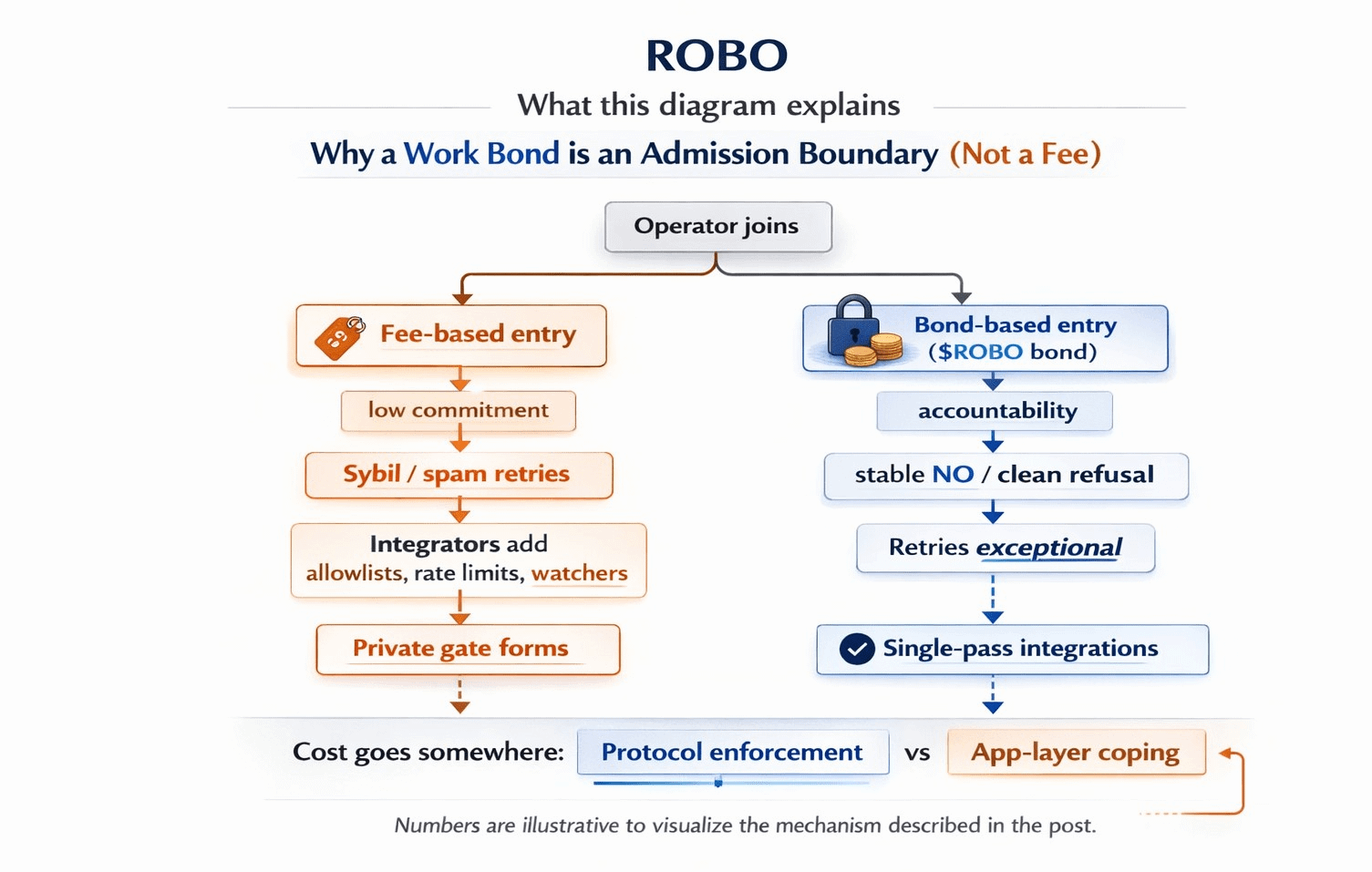
On paper, that sounds political. In practice, it’s purely mechanical. Any network that attracts genuine demand eventually builds a fast path. If the protocol doesn't define that path, the environment will invent one. The gate shifts from being a transparent rule to a dark art of routing quality, resubmission budgets, and identity games. The system stays open in the documentation, but in reality, access concentrates around whoever has the deepest pockets for clean infra and the most aggressive persistence.
There’s a line I keep chewing on:
Every open system eventually ships an admission policy. The only question is who writes it.
If the entry point is ambiguous, the ecosystem learns one reflex very quickly: Try again.
Once that reflex becomes the norm, the whole stack starts to warp. You see it happen in stages. First, you get guard delays. Then, complex backoff ladders. Then, you build watchers to reconcile everything because a success signal doesn't actually mean the work is done , it just means the request wasn't rejected yet. Eventually, known good providers become the only way serious teams interact with the system. This doesn't look like a crash; it looks like reliability engineering. But it’s actually an admission that entry isn't a point, it’s a range.
Why ROBO Hits Different
This is where the ROBO approach feels distinct. A bond or a stake isn't interesting because of the tokenomics. It’s interesting because it turns entry into a boundary that you can't negotiate for free. It’s the system choosing to make the gate legible instead of letting it become a private advantage for the most aggressive actors.
Most people miss this when they talk about open networks. Openness isn't a yes/no switch. It’s a decision of where the cost is billed.
If the protocol doesn't absorb the cost of admission when things get crowded, the application layer has to absorb it as coping. The bill shows up in wasted engineering hours and operator stress. The user pays for it in hesitation , that moment where Confirmed actually means Probably. Workflows stop being smooth; they become supervised.
The Power of a Stable No
I understand why a project like ROBO would make entry explicit from day one. If you’re building a shared work surface for robotics, you cannot have admission being negotiated at machine speed. You need a fast, stable Yes or No so that workflows don't learn to bargain with the system.
To make entry predictable, you have to be opinionated. You have to reject early. You have to narrow the patterns of success. Builders might call this restrictive, and they might be right, a stake-heavy posture can absolutely become a moat if it’s handled without humility.
But the alternative to this isn't openness. It’s a gate you aren't allowed to see. It’s a world where access is public, but practically decided by who can pound on the door the loudest and who can afford the best intermediaries.
If No isn't a stable state, then Try Again becomes the actual product.
The Test of Time
I don't see ROBO’s $ROBO staking and bond system as marketing fluff. I see it as an attempt to answer the admission question before the ecosystem invents a worse, invisible answer.
The token only matters if it makes that boundary expensive to cheat and sustainable to hold. If it fails at that, the hierarchy will just reappear anyway through private access markets and off-chain handshakes.
If $ROBO can keep entry predictable without letting that gate turn into a stagnant moat, that will be its greatest achievement. It won't be the robots. It will be a boundary that finally refuses to be ne#ROBO #Robo