
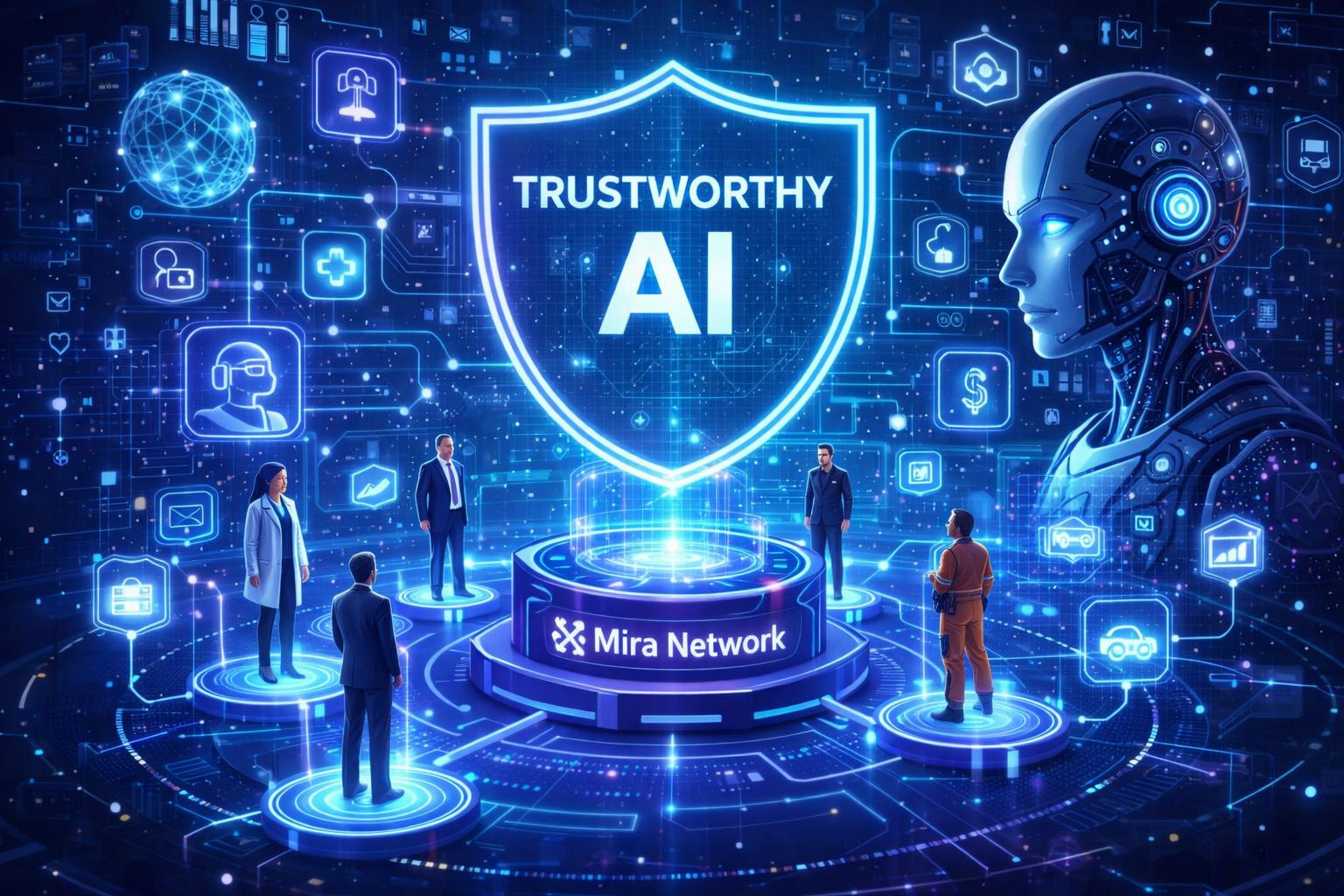
Artificial intelligence is rapidly becoming the engine behind modern life — powering healthcare diagnostics, financial systems, transportation, education, and governance. Yet beneath its impressive capabilities lies a critical flaw: AI systems are not inherently reliable. They hallucinate facts, amplify biases, misinterpret context, and sometimes produce dangerously confident wrong answers. This reliability gap is now the biggest barrier preventing AI from safely operating in autonomous and high-stakes environments.
This is where Mira Network enters the conversation — not as another AI model, but as a decentralized verification protocol designed to audit, validate, and certify AI outputs in real time.
The Reliability Crisis in Modern AI
Today’s AI models are trained on massive datasets scraped from the internet, books, and user interactions. While this scale gives them impressive general knowledge, it also introduces noise, misinformation, and bias. Unlike traditional software, AI doesn’t follow fixed rules — it predicts probabilities. That means even the most advanced systems can produce plausible yet incorrect outputs.
This unpredictability makes AI risky for autonomous use in areas like:
Self-driving transportation
Medical decision support
Legal and financial advisory
Critical infrastructure control
Defense and cybersecurity
Without a mechanism to verify outputs, organizations must rely on human oversight — defeating the purpose of automation.
Mira Network’s Decentralized Solution
Mira Network proposes a fundamentally different approach: trust through verification rather than blind confidence.
Instead of asking users to trust a single AI provider, the protocol distributes validation across a decentralized network of independent verifiers. When an AI generates an output, Mira’s system can:
Cross-check results against multiple models
Validate facts using trusted data sources
Detect bias or manipulation patterns
Assign a reliability score
Flag uncertain or risky responses
This process mirrors how blockchain verifies transactions — replacing centralized authority with distributed consensus.
Why Decentralization Matters
Centralized verification systems can be compromised, biased, or controlled by corporate interests. A decentralized protocol offers:
Transparency — Verification logic is open and auditable
Neutrality — No single entity controls truth validation
Resilience — No single point of failure
Trust Minimization — Users rely on math and consensus, not promises
In a future where AI agents negotiate contracts, manage resources, and make autonomous decisions, such trust infrastructure becomes essential.
Enabling Autonomous AI Safely
Reliable verification unlocks the next phase of AI evolution: safe autonomy.
Imagine:
AI doctors whose diagnoses are independently verified
Autonomous vehicles validated against safety protocols
Financial AI prevented from executing harmful trades
Government AI systems audited for fairness
Mira Network positions itself as the “trust layer” beneath intelligent systems — similar to how SSL certificates secure the web.
The Bigger Picture
As AI becomes more powerful, the question shifts from “What can AI do?” to “Can we trust what AI does?”
Protocols like Mira Network represent a new category of infrastructure: AI accountability systems. They acknowledge that intelligence without reliability is not progress — it is risk.
If successful, Mira’s approach could transform AI from a probabilistic tool into a dependable partner, enabling a future where autonomous systems operate not just efficiently, but responsibly.#Mira @Mira - Trust Layer of AI $MIRA
