
The Emerging Constraint: Intelligence Without Accountability
Artificial intelligence is no longer an experimental layer in the digital economy — it is rapidly becoming embedded in financial analysis, compliance automation, algorithmic trading, insurance underwriting, and DAO governance. Yet a structural asymmetry persists: AI can generate decisions at scale, but it cannot natively guarantee their correctness.
This imbalance is becoming economically relevant. Enterprises estimate that even small hallucination rates can translate into material financial risk when scaled across millions of automated decisions. In regulated industries, a single unverifiable output can trigger compliance exposure.
MIRA NETWORK approaches this challenge from an infrastructure perspective. Instead of attempting to build a better model, it focuses on constructing a verification layer that converts AI outputs into economically secured, cryptographically attested claims.
In other words, Mira treats trust not as a philosophical attribute — but as a programmable primitive.
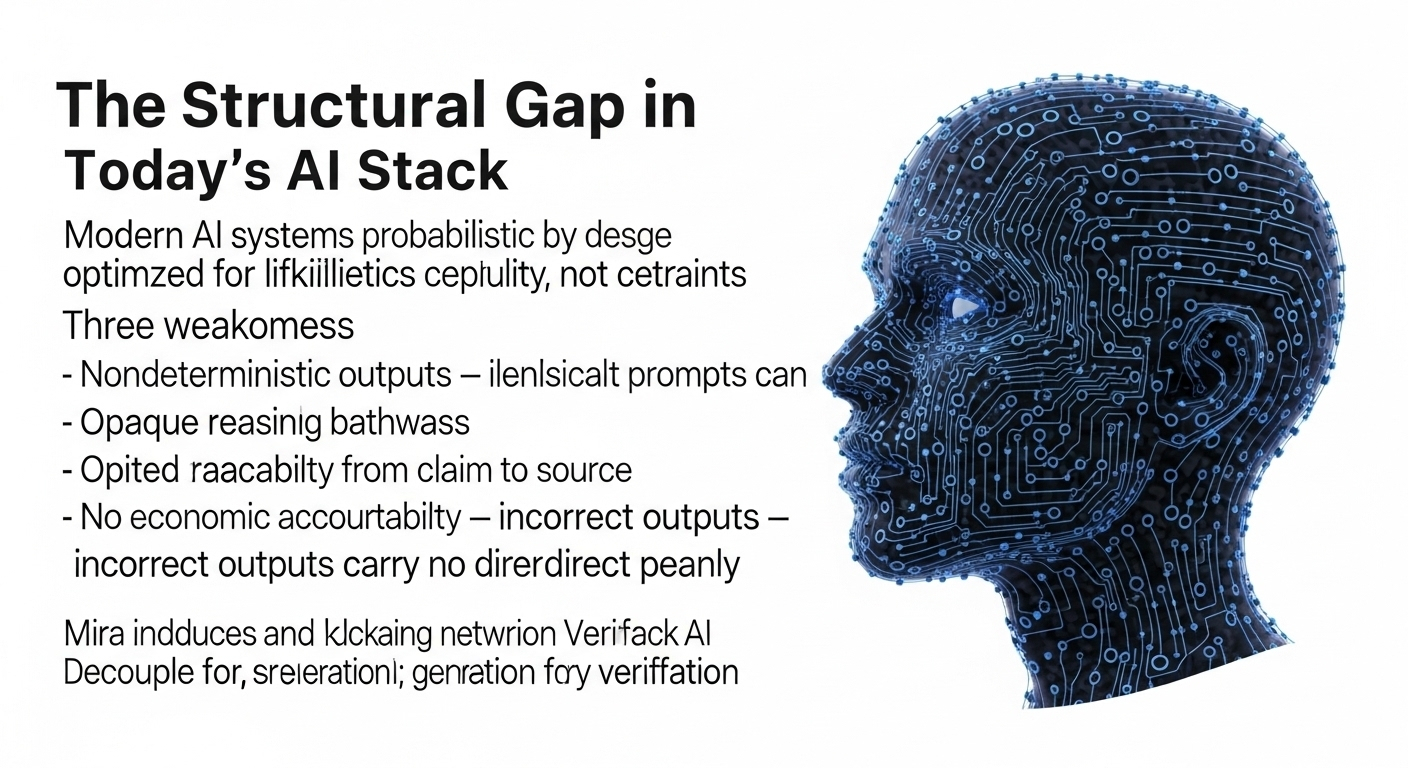
The Structural Gap in Today’s AI Stack
Modern AI systems are probabilistic by design. They optimize for likelihood, not certainty. This distinction is manageable in low-stakes environments but problematic in capital-intensive systems.
Three weaknesses define the current AI deployment model:
Non-deterministic outputs — identical prompts can yield different responses.
Opaque reasoning pathways — limited traceability from claim to source.
No economic accountability — incorrect outputs carry no direct financial penalty.
Traditional finance and blockchain networks resolved similar issues through layered verification. Financial audits, clearing mechanisms, and proof-of-stake validation exist precisely because trust must be enforced economically.
AI lacks this enforcement layer.
Mira introduces a structural solution: decouple generation from verification.
Architecture: Turning Claims into Verifiable Units
Mira’s design philosophy mirrors modular blockchain architecture — isolate responsibilities, then secure them independently.
1. Semantic Claim Decomposition
Rather than verifying entire documents, Mira decomposes outputs into atomic claims. For example, an AI-generated earnings summary becomes a series of discrete factual assertions: revenue growth percentage, EBITDA margin, geographic exposure.
This granular approach increases parallelization and reduces systemic failure risk. Smaller claims are easier to validate, dispute, and economically score.
2. Distributed Ensemble Verification
Each claim is evaluated by multiple independent verifier agents. These agents may include domain-specialized AI systems or structured validator nodes.
The consensus model aggregates attestations into a confidence score. Validators stake tokens to participate, and dishonest attestations face economic penalties.
This resembles proof-of-stake security dynamics but applied to semantic accuracy rather than transaction ordering.
The key innovation lies in diversity. Correlated model failure becomes less likely when heterogeneous systems independently assess the same claim.
3. On-Chain Attestation Layer
Verified outputs are anchored on-chain as cryptographic certificates. Applications can programmatically query these attestations before executing high-stakes actions.
This transforms AI outputs from ephemeral text into durable, auditable records.
For DeFi protocols, DAOs, and RWA platforms, such attestations introduce a new decision checkpoint: execution conditioned on verified intelligence.
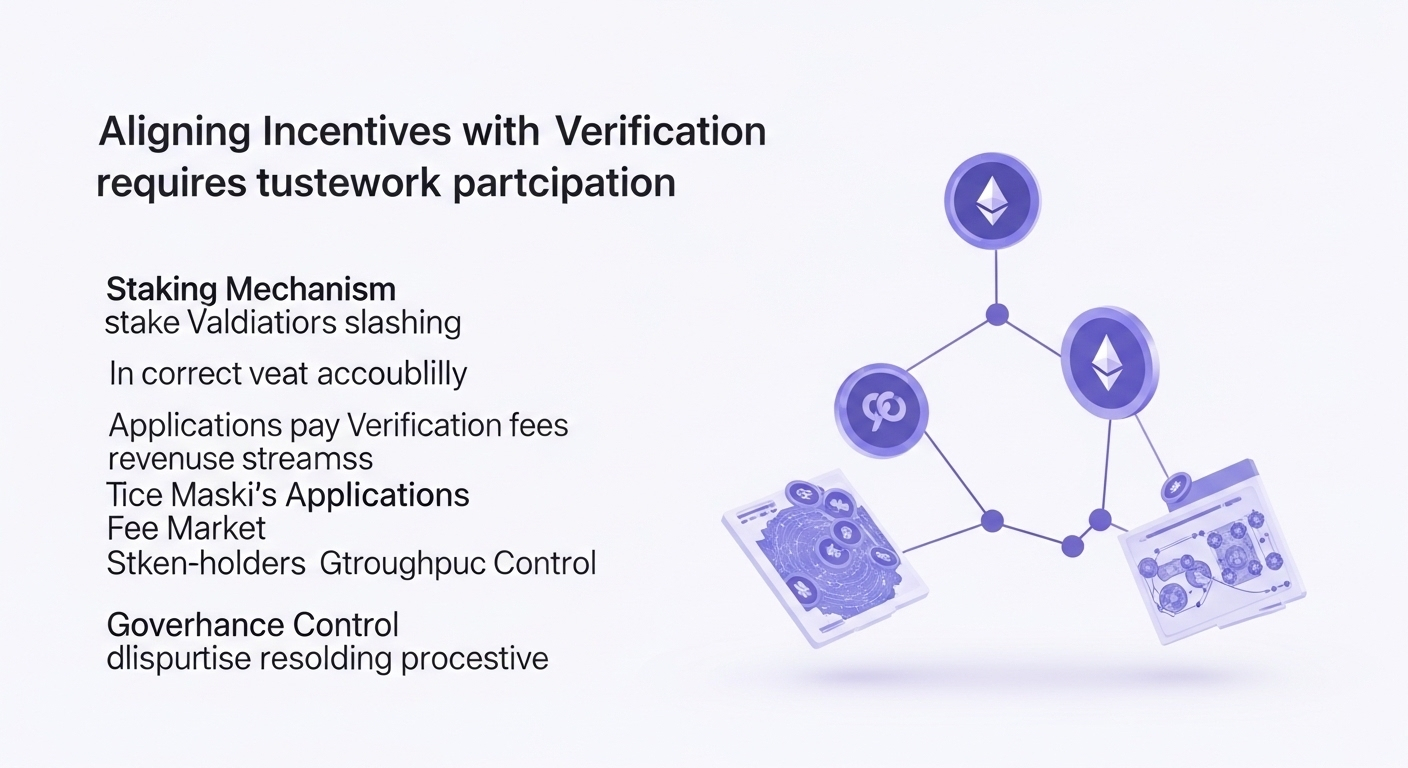
Economic Design: Aligning Incentives with Truth
Verification requires sustained participation. Mira’s token model is structured to support long-term network integrity.
Staking Mechanism: Validators stake tokens to participate. Incorrect verification risks slashing, creating financial accountability.
Fee Market: Applications pay verification fees, generating revenue streams tied to actual demand rather than speculative issuance.
Governance Control: Token holders influence verification standards and dispute resolution processes.
The economic sustainability of this model depends on throughput efficiency. Verification must remain cost-effective relative to enterprise risk exposure.
If AI-assisted financial decisions represent billions in value, allocating basis points for structured verification becomes rational. The market viability hinges on maintaining that ratio.
Market Context: Positioned at the Intersection of AI and On-Chain Infrastructure
Mira operates at a convergence point between two dominant trends:
AI integration into financial systems
On-chain transparency and programmable compliance
While oracle networks validate external data feeds, they are not optimized for semantic claim verification. Conversely, AI marketplaces focus on compute distribution, not output accountability.
Mira’s positioning is closer to trust middleware — analogous to how SSL certificates enabled secure web commerce.
Its relevance increases as:
DeFi protocols integrate AI-based analytics.
RWA platforms tokenize real-world assets requiring structured documentation review.
DAOs automate proposal drafting and treasury strategy through AI tools.
In each scenario, verified outputs reduce execution risk.
Data-Driven Insights and Projections
To assess viability, consider broader industry metrics:
1. AI Error Impact Scaling
Enterprise AI deployment surveys indicate that even a 2–5% factual error rate can translate into disproportionate compliance costs when applied across automated pipelines. If AI-driven financial reporting processes scale to millions of outputs annually, error mitigation becomes economically necessary rather than optional.
Projection: Within three years, high-value AI pipelines (finance, healthcare, legal) may allocate dedicated verification budgets representing 3–7% of AI operational expenditure.
2. RWA and On-Chain Documentation Growth
The tokenized real-world asset market has expanded significantly over the past two years, with on-chain treasuries and credit products growing into multi-billion-dollar segments. As documentation and risk disclosures move on-chain, AI-assisted analysis will require auditability.
Projection: Verification layers could become standard infrastructure for institutional-grade RWA protocols by the next market cycle.
3. Validator Economics Parallel
Proof-of-stake networks have demonstrated that economic incentives can secure trillions in value with predictable validator returns. If semantic verification adopts similar staking dynamics, validator yield models may stabilize around service-driven revenue rather than inflationary emissions.
This transition would align Mira with sustainable network economics rather than short-term token incentives.
Growth Catalysts
Enterprise API Integration:
Adoption accelerates if verification can be embedded with minimal architectural overhaul.Regulatory Alignment:
Jurisdictions increasingly emphasize explainability and audit trails for AI. Mira’s attestation model aligns with those regulatory directions.Composable Smart Contract Integration:
Protocols that condition execution on verified claims introduce a new design paradigm for AI-informed finance.
Structural Risks
Despite architectural strengths, several risks remain:
Verifier Collusion: Diversity must be actively managed.
Latency Constraints: Real-time applications require optimized consensus pathways.
Model Improvement Compression: As base AI models improve, the marginal value of external verification must remain clear.
Regulatory Divergence: On-chain attestation of AI outputs may intersect with data governance laws.
The project’s trajectory depends on navigating these constraints without compromising decentralization or cost efficiency.
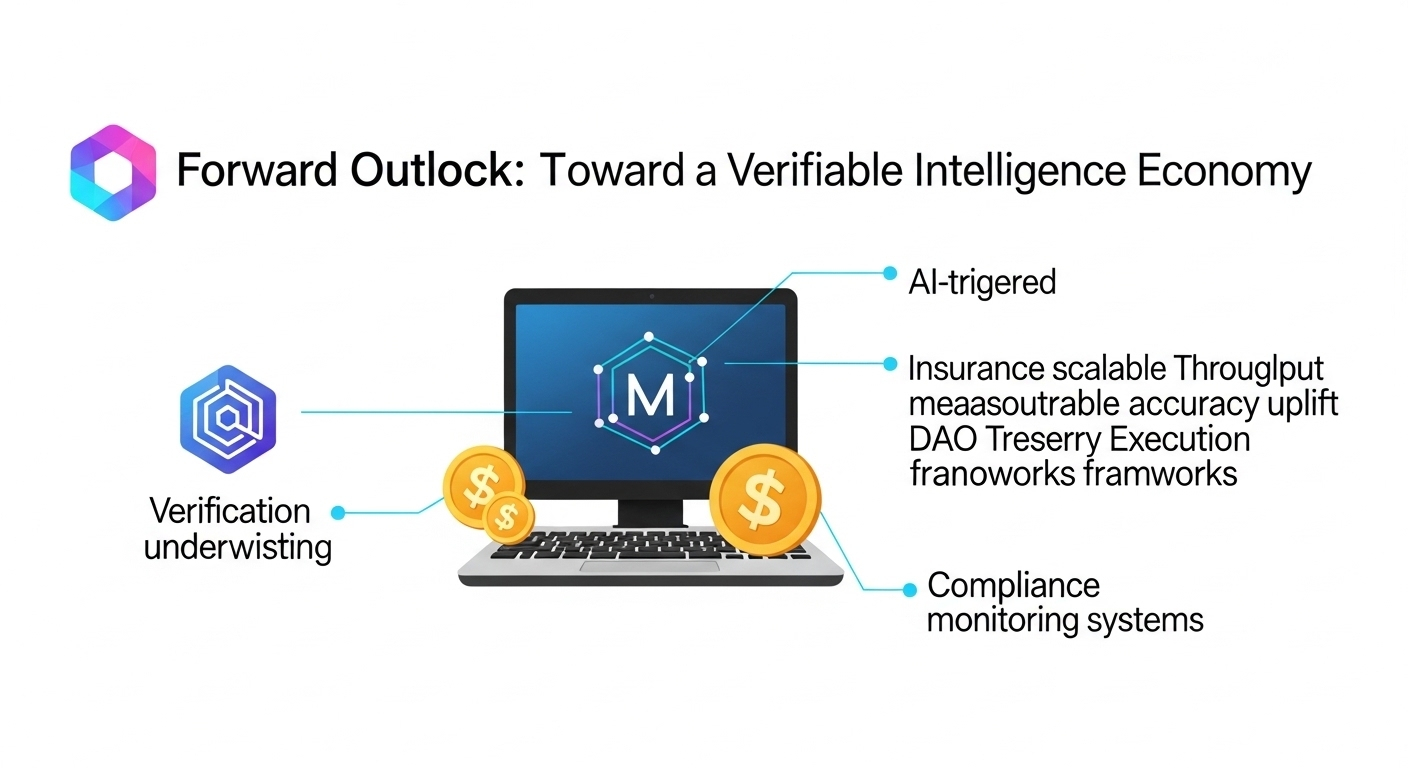
Forward Outlook: Toward a Verifiable Intelligence Economy
AI adoption is unlikely to slow. Instead, differentiation will shift from model capability to output reliability.
In that environment, trust infrastructure becomes strategic. Verification networks may underpin:
AI-triggered financial contracts
Insurance underwriting automation
DAO treasury execution frameworks
Compliance monitoring systems
If Mira achieves scalable throughput and measurable accuracy uplift, it could evolve into foundational infrastructure for AI-integrated blockchains.
More broadly, the emergence of verification layers suggests a shift in digital architecture: intelligence will no longer be accepted at face value. It will require economic backing.
Conclusion: From Probabilistic Output to Programmable Trust
Mira Network addresses a structural weakness in the AI economy — the absence of enforceable trust. By decomposing outputs into claims, applying distributed consensus, and anchoring attestations on-chain, it introduces accountability into a probabilistic system.
The significance lies not in speculative upside, but in architectural necessity. As AI becomes embedded in capital allocation, governance, and compliance systems, verification will transition from optional safeguard to required infrastructure.
If execution aligns with design — scalable verification, sustainable validator economics, and enterprise integration — Mira could represent an early blueprint for how blockchains secure not just transactions, but intelligence itself.
In a market increasingly defined by the convergence of AI and decentralized finance, programmable trust may become the next critical layer.
@Mira - Trust Layer of AI
#Mira
$MIRA