
@Fogo Official I was at my kitchen table at 7:08 a.m., laptop fan whining, when a friend sent me a Fogoscan link and wrote, “It says failed—what now?” I care because I’m the person my circle pings when money gets stuck on-chain, and lately those pings have piled up. Is it user error, or something deeper?
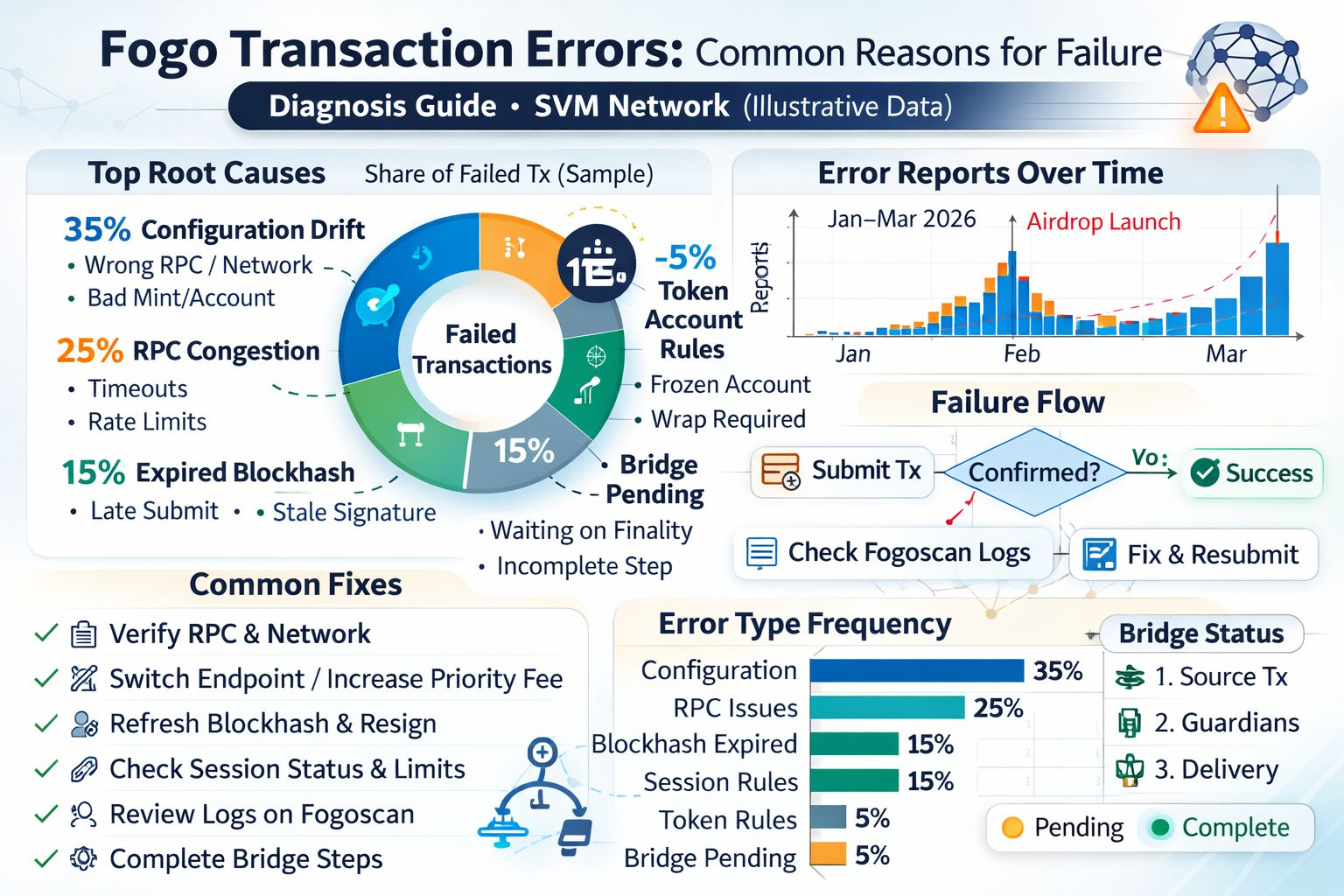
The timing explains a lot. Fogo’s $FOGO airdrop claim portal went live in mid-January 2026 and stays open for 90 days, pulling in wallets that don’t normally touch an SVM network. Around the same window, Fogo acknowledged a Season 1 Flames display bug that made some EVM wallet scores look wrong, which primed people to distrust what they were seeing. More traffic plus more anxiety is how “transaction errors” becomes a trend.
When I dig into individual failures, the most common root cause is configuration drift. Fogo is SVM-compatible, so Solana tools can talk to it, but only if I’m pointed at the right RPC and the right network. Mainnet and testnet are different worlds with different accounts and mint addresses; a transfer can be perfectly formed and still fail because the mint or destination account doesn’t exist where I’m sending it. I check the RPC URL before anything else.
The second bucket is connectivity and capacity. The Foundation runs public RPC endpoints, and they’re great until everyone hits them at once. Timeouts, intermittent responses, or rate-limiting can make a transaction look broken from the client side. I see this when someone refreshes a dApp repeatedly, spawns requests, and then wonders why nothing confirms. Switching endpoints or using a higher-throughput provider can turn a “mystery failure” into a normal confirmation.
Some failures are about time, not funds. Like Solana, every transaction carries a recent blockhash that expires quickly. If I sign, get interrupted, and submit too late, the network rejects it even though the signature is fine. That’s why retries with the same signed transaction often keep failing; the fix is to rebuild with a fresh blockhash.
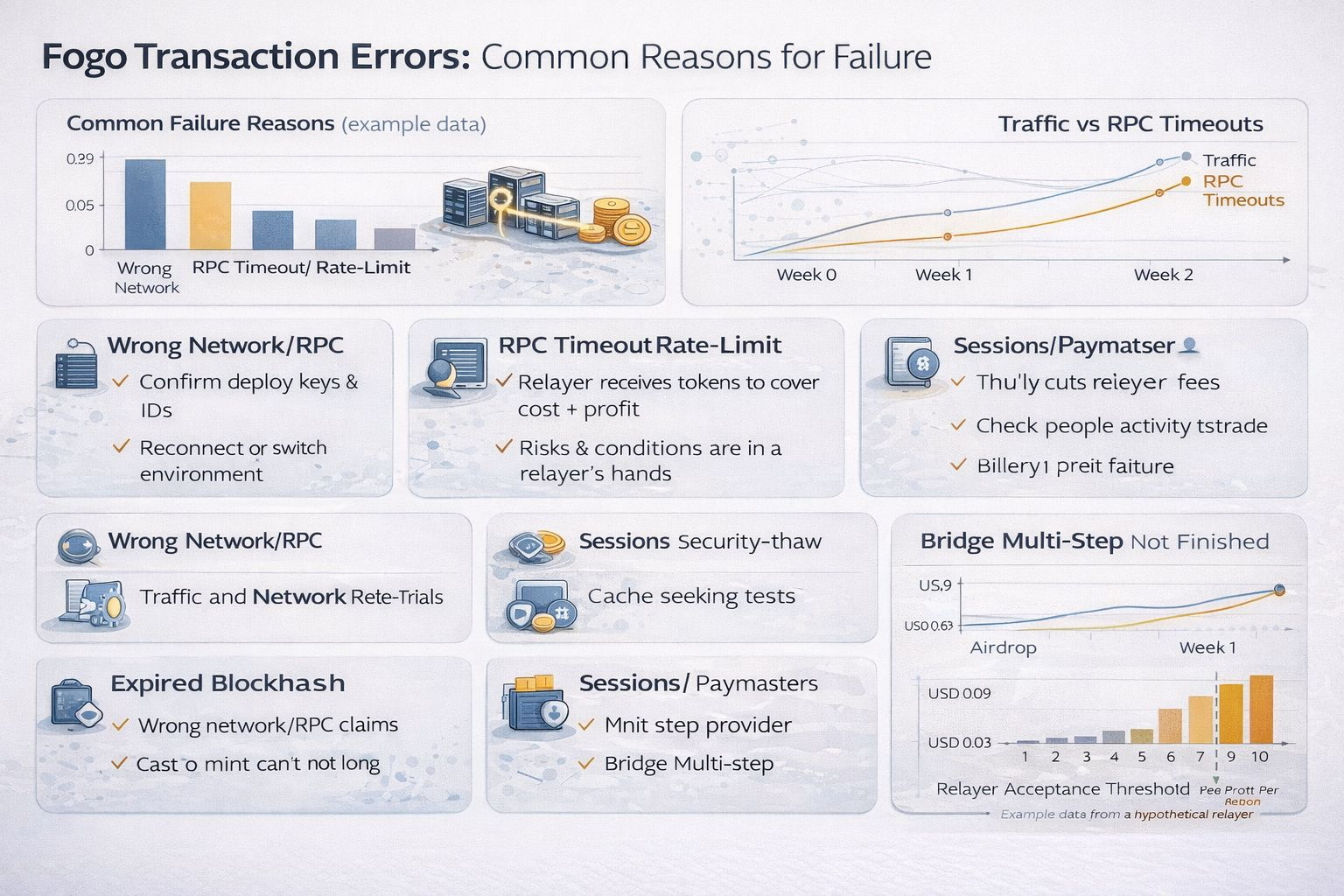
Fogo Sessions is where the error stories get more specific. Sessions use paymasters to sponsor fees, and they enforce boundaries with domains, program registries, and expiration. If my session is expired, or an app tries to call a program outside its registry, the paymaster path can reject the request before it behaves like a normal transaction. I also watch for asset-handling edge cases: sessions are designed around SPL tokens, and apps may expect Wrapped FOGO rather than native FOGO in a wallet, so a “failed transfer” can really be “you skipped the wrap step.”
Then there are the on-chain rule failures that only make sense once I read the actual logs, and on Fogo that usually means opening the transaction in Fogoscan and expanding the program output. Because Fogo runs an SVM environment, the failure patterns look a lot like Solana’s: a program returns an error, and the UI turns it into one vague “failed.” Where I see people get tripped up is with token behavior. If a token mint uses rules that leave new accounts frozen by default, a perfectly normal transfer can be rejected until the freeze authority thaws the account, and the only place I reliably see that story is in the logs. When I’m stuck, I stop debating what a front end “meant” and treat Fogoscan as the source of truth.
Bridges deserve their own mention because on Fogo, “failure” is often just “not finished.” Wormhole’s flow is multi-step—message emission on the source chain, guardian attestation, then delivery and execution on the destination—so a user can do the first part correctly and still be waiting on the later step. The community guidance also matters here: transfers to and from Fogo are described as live via Portal Bridge, Mayan, or the bridging extension inside Fogo Sessions, with USDC called out as the currently supported asset in that workflow. When someone tells me their bridge “failed,” I check whether their source-chain transaction actually succeeded, then I look for the matching Fogo-side transaction on Fogoscan before I accept that anything broke.
I’m not blind to the rough edges, but I do see practical progress in how Fogo makes the basics diagnosable. Mainnet has a public RPC endpoint, and the docs are explicit about what to point tools at, which reduces the “wrong network, wrong endpoint” confusion that causes so many phantom errors. On top of that, Sessions adds guardrails that are clearly documented—domain matching, token limits for limited sessions, and expiry—plus paymasters that can sponsor fees, which is convenient but also introduces session-specific ways a transaction can be refused. When I keep those Fogo-specific rules in mind and lean on Fogoscan logs instead of UI summaries, most failures collapse into a short, fixable explanation.

