
Vanar Chain represents a new direction in blockchain design where the focus moves beyond transaction processing toward data understanding and automated reasoning. The project positions itself as an AI native Layer 1 blockchain built to embed intelligence directly into its protocol so applications can interact with data in a meaningful way rather than executing rigid logic alone.
The core idea behind Vanar is simple yet ambitious. Traditional blockchains operate as secure ledgers that record events but rely heavily on external systems for storing meaningful content and interpreting context. This creates fragmentation and trust gaps where the blockchain verifies transactions but cannot understand or analyze the underlying information. Vanar aims to close this gap by creating an infrastructure where data storage reasoning and automation exist within the same ecosystem.
The project evolved from earlier work in gaming and digital entertainment where complex data identity and automated interactions were essential. This background shaped a vision for a blockchain capable of handling richer information and supporting intelligent applications across industries such as payments tokenized assets and gaming economies.
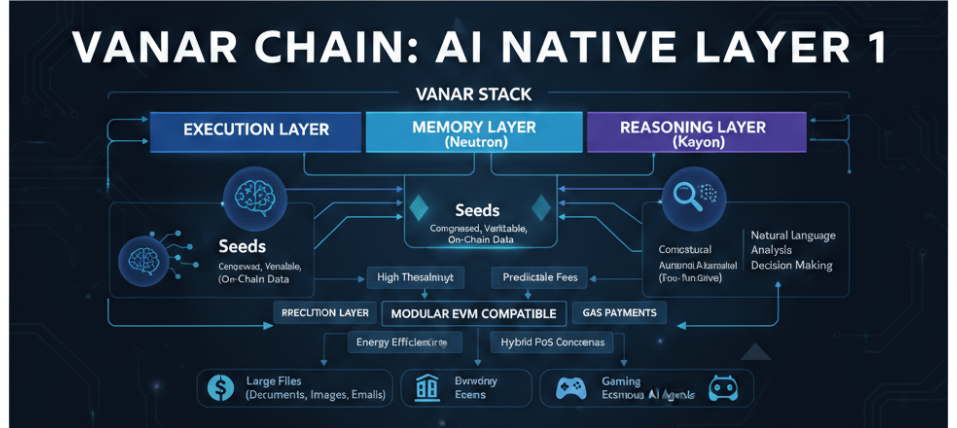
Vanar is structured as a modular EVM compatible Layer 1 blockchain designed for high throughput predictable fees and energy efficiency. The network uses a hybrid proof of stake consensus model that balances decentralization with performance while enabling AI driven workloads that require stable transaction costs and fast confirmation times.
A defining aspect of Vanar is its multi layer architecture known as the Vanar Stack. This design integrates execution memory and reasoning layers into a unified infrastructure capable of supporting intelligent workflows.
At the center of this stack is Neutron which functions as a semantic memory layer. Neutron compresses large files into compact AI readable units called Seeds that remain verifiable and accessible on chain. These Seeds can represent documents images emails or structured knowledge allowing applications and agents to interact with contextual information rather than raw data fragments.
Neutron addresses a long standing blockchain limitation often described as the storage illusion where data referenced by smart contracts resides off chain and depends on fragile links. By enabling compressed yet meaningful storage Neutron provides persistent data availability while reducing bandwidth demands and storage costs.
Complementing Neutron is Kayon which acts as the reasoning engine of the network. Kayon allows natural language queries contextual analysis and automated decision making based on the data stored within Neutron. Smart contracts can therefore read interpret and act on information rather than executing static rules.
This combination transforms the blockchain from a passive ledger into an environment where intelligent applications can reason with stored knowledge. It enables use cases such as automated payments triggered by invoice verification compliance workflows that analyze contract content and AI agents capable of managing financial tasks.
Scalability within Vanar is approached through intelligent compression rather than raw throughput competition. By reducing data size before storage and enabling contextual retrieval afterward the network minimizes resource consumption while maintaining accessibility. This design reflects a philosophy centered on efficiency and meaningful data availability rather than transaction speed metrics alone.
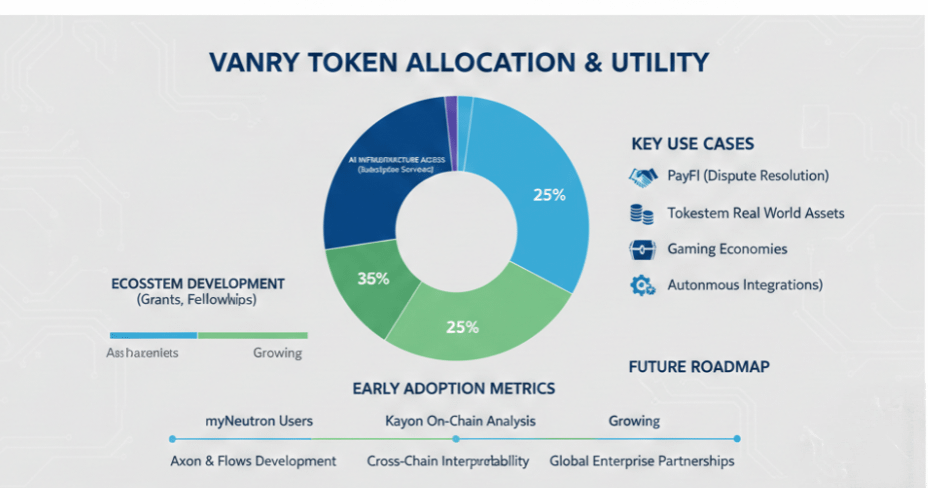
The VANRY token serves as the economic backbone of the ecosystem with multiple roles that include gas payments staking governance and access to AI infrastructure tools. As subscription based AI services expand token demand becomes increasingly linked to platform usage creating an economic model driven by real application activity.
Tokenomics also incorporate mechanisms such as buyback and burn events tied to AI service adoption which may influence long term supply dynamics and network incentives.
Vanar’s ecosystem focuses on real world applications rather than purely speculative finance. Key areas include PayFi infrastructure where immutable data Seeds support dispute resolution and fraud reduction tokenized real world assets where AI assists with ownership verification and compliance gaming economies that leverage persistent memory for player assets and rewards and autonomous AI agents capable of managing portfolios executing DeFi operations and coordinating workflows using contextual reasoning.
Early adoption signals include operational tools such as myNeutron and Kayon which allow users to create semantic memory from uploaded files and perform on chain analysis. Partnerships and integrations in payments and enterprise environments demonstrate the project’s ambition to bridge Web3 with practical industry needs.
Vanar also supports developer growth through fellowships grants and accelerator programs aimed at building applications across sectors including DeFi gaming identity management and carbon credit markets. These initiatives reflect a strategy focused on ecosystem expansion rather than isolated infrastructure development.
Despite its innovative architecture the project faces several challenges. The technical complexity of on chain AI reasoning requires significant optimization to achieve scalability and cost efficiency. Competition from established Layer 1 networks and emerging AI blockchain platforms creates pressure on developer adoption. Additionally bridging narrative excitement with sustained real world usage remains a key determinant of long term success.
Market positioning places Vanar as foundational infrastructure for what many describe as the intelligence economy where data context automation and AI agents drive value creation. Rather than competing solely on speed or decentralized finance features the project aims to become the base environment where intelligent applications operate.
The future roadmap highlights continued development of the intelligence stack including upcoming layers such as Axon and Flows expansion of subscription based AI tooling cross chain interoperability enterprise integrations and broader developer ecosystem growth. These steps indicate a gradual evolution toward a comprehensive AI enabled operating layer for Web3.
Vanar Chain ultimately represents an experiment in redefining blockchain functionality. Its architecture reflects an attempt to move decentralized infrastructure from static execution toward contextual reasoning where data is not only stored securely but also understood and acted upon by intelligent systems.
Whether this vision achieves widespread adoption remains uncertain but the direction it explores carries meaningful implications for the future of digital infrastructure. If successful the integration of memory reasoning and automation within blockchain networks could reshape how finance identity ownership and digital coordination operate across decentralized ecosystems.
Innovation in blockchain has historically emerged from incremental improvements in security scalability and usability. Vanar introduces a different dimension focused on intelligence and contextual understanding. This shift may redefine expectations for decentralized platforms as the convergence of AI and blockchain accelerates.
In the broader narrative of Web3 Vanar’s story highlights a transition from transactional infrastructure toward cognitive infrastructure where decentralized systems participate in interpreting information and enabling automated decision making.
The long term impact of this approach will depend on consistent development transparent governance and tangible adoption across industries. Trust in infrastructure is rarely built through promises alone but through reliable performance real usage and the quiet accumulation of credibility over time.
Vanar’s journey is still unfolding yet it reflects a deeper movement within blockchain innovation. A movement toward systems that do not merely record digital activity but help make sense of it. If this direction proves viable the legacy of projects like Vanar may lie not in market dominance but in shaping the foundations of intelligent decentralized infrastructure for the years ahead.
