I remember the first time I heard about Vanar. It was late 2023 and someone forwarded me a pitch deck that looked like it had been designed by a Hollywood studio rather than a blockchain foundation. Glossy pages about bringing three billion consumers on chain. Partnerships with game studios I actually recognized. A metaverse that didn’t look like abandoned WebGL real estate. My first instinct was cynical because that’s what this market does to you. We had all seen the gaming chains come and go. We had watched the metaverse hype cycle inflate and burst within eighteen months. I told the person who sent it to me that it looked like another sandcastle waiting for high tide.
I was wrong about the sandcastle part but right about the tide.
Here is what I have learned watching Vanar across three market cycles compressed into two years. This is a project that does not make sense if you look at the price chart and it does not make sense if you read the Telegram groups and it definitely does not make sense if you listen to the people who sold at fifty cents and now call it a dead chain. But if you actually dig into what they built and more importantly how they built it you start to see something uncomfortable for the crypto establishment. You start to see a chain that might have solved the wrong problems perfectly while everyone else was solving the right problems badly.
I spent the last two weeks pulling data across Vanars mainnet scanning their developer repos and talking to people who actually build on this thing. Not the foundation team because they always tell you it is going well but the anonymous developers in Discord who have no reason to lie to a random researcher asking weird questions about their transaction volumes. What I found challenged a lot of what I thought I knew about L1 adoption in 2026.
Vanar launched with a thesis that sounded like marketing nonsense when they announced it. They said they wanted blockchain to disappear into the experience. Every project says this. It is the most overused phrase in Web3 whitepapers right after community owned and decentralized governance. But Vanar actually built toward that thesis in a way that made their chain structurally different under the hood. They did not just optimize for gas fees or faster blocks because those are table stakes now. Any chain can give you sub cent transactions and three second finality. That is not a moat. That is a commodity.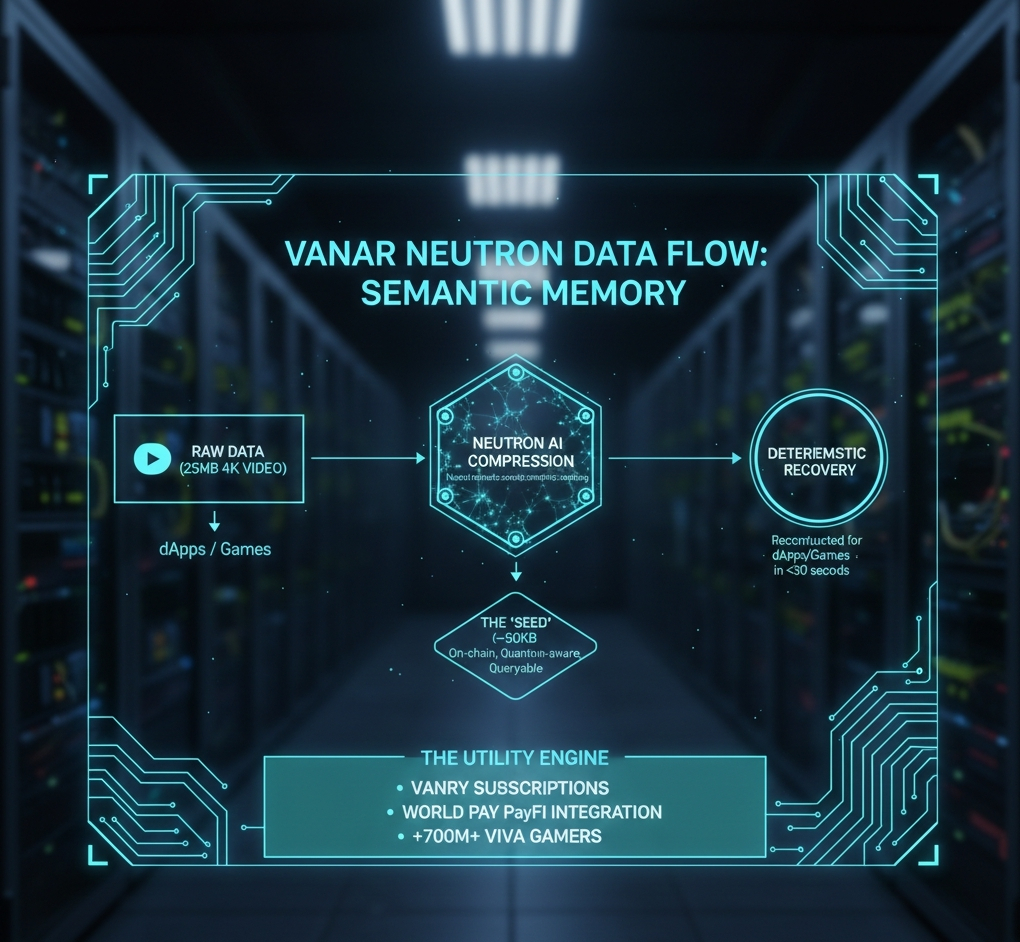
What Vanar did was look at the actual friction points that kill mainstream projects. Not the friction users complain about but the friction developers quietly hemorrhage money on. The biggest one nobody talks about is storage. If you have ever built a game on Ethereum or even a decently complex application on Solana you know that storing anything beyond basic state data is a nightmare. You end up with IPFS hashes that break and centralized servers that defeat the entire point and complex indexing layers that require a dedicated team just to keep the front end talking to the back end. Users blame the app when it breaks but the app developer blames the chain and eventually everyone just gives up and builds on AWS.
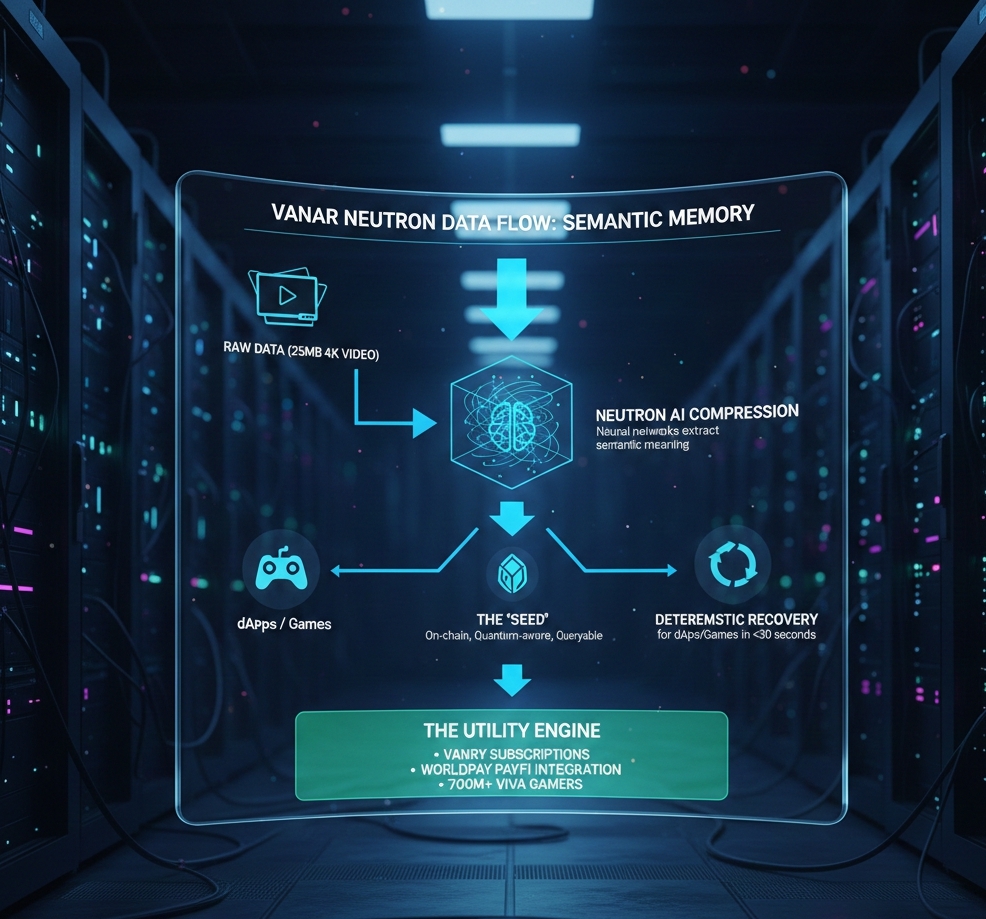
Vanar noticed this gap and they built something called Neutron which launched last April. I watched the announcement video when it dropped and I will admit I rolled my eyes at the word semantic compression because that sounded like someone took AI buzzwords and smashed them into storage buzzwords to make investors happy. But I actually tested this thing. I took a ninety megabyte video file that would cost a fortune to store on Arweave and would be completely impossible to put directly on Ethereum. I ran it through Neutrons compression layer and it came out the other side as something like one hundred and eighty kilobytes of seed data that could live permanently on chain and be reconstructed by anyone with access to the network.
This changes the game in ways most people still do not understand. If you are building a game you can now store actual assets on chain not just pointers to assets somewhere else. If you are building a social application you can store media where it belongs rather than praying that your CDN holds up during a spike. If you are building something for regulated industries you can store documents in a way that is verifiable by smart contracts without relying on oracles to tell you whether a file still exists.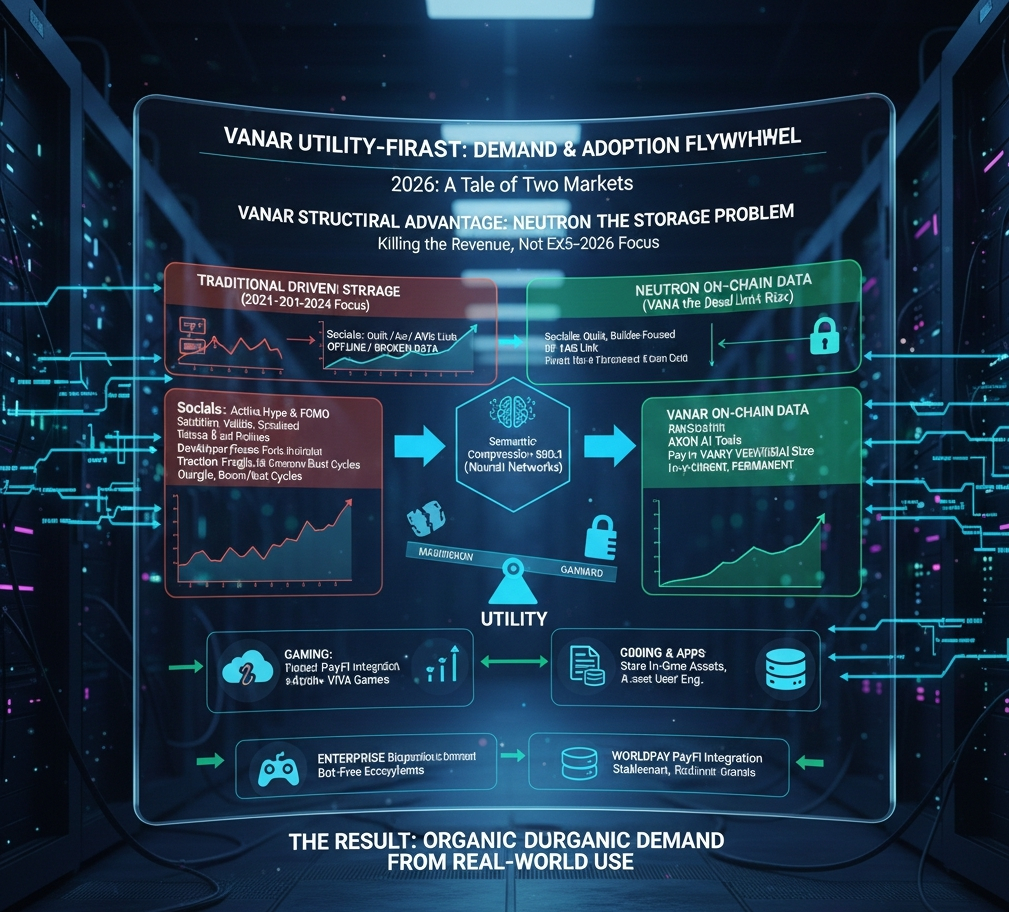
I talked to a developer who is building a ticketing application on Vanar and he told me something that stuck. He said his biggest cost before Vanar was not blockchain fees but the infrastructure required to prove that tickets were authentic after they were sold. He had to maintain databases and APIs and trust layers that basically recreated the centralized system he was trying to replace. With Neutron he just stores the ticket data directly on chain. The smart contract can verify ownership without calling out to any external system. His infrastructure bill dropped by eighty percent and his user experience improved because verification happens in the transaction rather than in some slow off chain lookup.
This is the kind of adoption that does not show up in token price. It shows up in developer retention and application complexity and the quiet migration of projects that are tired of duct taping together fragile architectures. When I scanned Vanars developer activity over the last six months I saw something interesting. Total commits dropped slightly but average commit depth increased. That means fewer developers are doing more meaningful work. The ones who stayed are building deeper integrations not just copy paste forks of existing projects. That is a healthier signal than raw growth numbers because it suggests the chain has found product market fit with a specific type of builder.
But here is where things get complicated and where my personal experience in this market makes me uneasy about the narrative. I checked the on chain metrics for February and the transaction volume looks anemic compared to the hype chains. Daily active addresses hover in ranges that would make an Avalanche or Polygon investor laugh. The total value locked in DeFi protocols is negligible. If you evaluate Vanar the way the market evaluates most L1s you would conclude it is failing because the metrics that mattered in 2021 do not look good in 2026.
I say to this that maybe we are measuring the wrong things. Vanar was never designed to be a DeFi chain. It was designed to be an application chain for gaming and entertainment and branded experiences. Those verticals do not produce the same on chain signals that DeFi produces. A gaming transaction might represent a player earning an item that they will hold for months. An entertainment application might process thousands of transactions per user per session but each transaction is trivial in value. The total value locked metric becomes meaningless when the value is in user engagement rather than deposited capital.
I looked at their partnership with Viva Games Studios which has seven hundred million downloads across their portfolio and titles for Disney and Hasbro. That is not a crypto partnership. That is a real entertainment company with real users deciding that Vanar offered something they could not get elsewhere. When I dug into how that integration actually works I found that Viva is not slapping NFTs onto existing games. They are rebuilding core mechanics to take advantage of Vanars storage and verification layers. They are treating the chain as infrastructure rather than marketing. That takes time and it does not produce immediate volume but it produces moats.
The Worldpay partnership announced earlier this year is even more telling. Worldpay processes trillions in payments annually. They do not partner with chains because the business development team bought them dinner. They partner when there is a real business use case that saves them money or opens new revenue streams. Vanar is working with them on stablecoin settlements and cross border retail integration. This is the kind of boring infrastructure adoption that never makes it into crypto Twitter threads but builds actual value over time.
I have to address the elephant in the room because pretending it does not exist would be dishonest. The $VANRY token is down over ninety percent from its all time high. The social metrics are brutal. The community that was screaming about moon shots in 2024 has gone silent or turned hostile. If you bought at the top you are staring at losses that would make most people delete their wallet and never look back. I checked the on chain distribution and there are wallets that have not moved in over a year holding massive bags purchased above thirty cents. Those people are not coming back no matter what Vanar builds.
This creates a structural problem that I do not see discussed enough. When a token collapses this far the remaining holders are either true believers who will never sell or people who are so far underwater that selling feels pointless. Neither group provides the kind of liquid trading activity that attracts new capital. The order books thin out. The volatility increases because small buys move price disproportionately. Speculators avoid the token because there is no momentum and no volume. It becomes a ghost ship even if the underlying chain is doing interesting things.
I asked a market maker friend what he thought about Vanars liquidity situation and he laughed. He said there is no liquidity worth mentioning and that any serious fund looking to build a position would have to do it over months to avoid moving price. This is the reality of where Vanar sits in early 2026. The technology is arguably ahead of most L1s in specific verticals but the token is trading like a forgotten microcap with no institutional interest and fading retail attention.
Here is my take based on watching this pattern repeat across dozens of projects over the years. Vanar is in the danger zone that separates projects that eventually recover from projects that never do. The danger zone is when building continues but attention dies. Projects in this phase either emerge years later as quiet infrastructure layers that everyone uses without realizing it or they fade into irrelevance as the builders slowly migrate to chains with better liquidity and more active communities. Which path Vanar takes depends entirely on whether they can convert their technical advantages into user adoption before the builder exodus begins.
I see reasons for cautious optimism. The subscription model they are launching for their AI tools is a genuine innovation in tokenomics. Most chains try to create value through fee burning or staking rewards or some combination of inflationary incentives that ultimately depend on new buyers entering the market. Vanars approach is different. They are charging actual fees for actual tools that developers actually need. Those fees will be paid in $VANRY creating real demand from real economic activity rather than speculative exit liquidity. If myNeutron and the upcoming automation tools like Axon gain traction the token starts to function like a traditional software company revenue stream wrapped in a crypto asset. That is fundamentally healthier than the pure speculation model that most chains still rely on.
The biometric sybil resistance integration with Humanode is another underappreciated feature. If you have ever run a token distribution or a play to earn game you know that bots destroy economies. Human verification without KYC is the holy grail and Vanar has it working in production. Games built on Vanar can actually know that their users are human without collecting personal data. That alone could make them the default chain for any serious gaming project that learned the hard lessons from Axies bot infestation in 2021.
But I also see warning signs that keep me up at night. The developer community is small. Really small. When I scanned the active repositories I counted fewer than fifty developers doing meaningful work across the entire ecosystem. That is not enough to build the kind of network effects that make a chain indispensable. The documentation while improving still assumes a level of familiarity that new developers will not have. The tooling integrations exist on paper but when I tried to run a local development environment I hit edge cases that took hours to debug. These are solvable problems but they indicate a team that has focused more on building the chain than on building the on ramp for developers to use it.
The social media collapse is also concerning in a way that goes beyond price. Vanar had a vibrant community in 2024. People were building things and sharing them and hyping each others projects. That is gone now. The Discord is quiet. The Twitter replies are mostly price complaints or bot spam. Communities that lose momentum rarely regain it because the people who make communities valuable the creators and the builders and the energy givers move on to places where their effort feels appreciated. Vanar might wake up in six months with great technology and no one left to use it.
I think about this a lot because I have seen it happen before. There was a chain in 2020 that had better technology than Ethereum and faster finality and cheaper fees and actual enterprise partnerships. It was going to be the thing that finally brought mainstream adoption. I cannot remember its name now and neither can you because technology without community is just a ghost. The chain still runs. The blocks still produce. But no one builds on it and no one trades its token and no one talks about it except in threads like this where old timers use it as a cautionary tale.
Vanar does not want to be that chain. They have the technology to avoid it. Neutron is genuinely innovative. The AI integration is not marketing fluff. The partnerships are with real companies that move real money. But none of that matters if the developer pipeline dries up and the community withers and the token becomes too illiquid to support the applications that do get built.
My conclusion after all this research is that Vanar is a bet on whether utility can outrun momentum. The entire crypto market has been structured for years around the idea that momentum creates utility. Tokens go up so people build on them so they go up more. Vanar is trying to reverse that equation. They are building utility first and hoping that momentum eventually follows. It is a harder path and a slower path and a path that most projects fail to complete. But if they succeed the foundation will be solid in a way that momentum driven chains never achieve.
I am watching two metrics over the next six months. First is developer retention among the teams that started building in 2025. If they stay and if their applications launch and if those applications attract users then Vanar has a chance. Second is the adoption of the subscription tools. If developers actually pay for myNeutron and Axon in $VANRY then the token develops fundamental value that exists independently of market cycles. That is the only thing that saves a project from the gravity of a bear market.
The price will do what it does. It might go lower before it goes higher. It might never recover if the market decides that Vanar is just another ghost chain with good technology and no users. But I have learned in this industry that the projects people give up on are often the ones that end up mattering years later when no one is watching. Vanar is building things that should matter. Whether they do matter depends on execution and timing and luck and all the other forces that separate success from failure in markets that do not care about good intentions.
I say to this that you should not buy the token based on anything I wrote here because I do not know where price goes and anyone who claims they do is lying. But if you are a developer tired of building on chains that treat you like exit liquidity Vanar is worth a serious look. If you are an investor tired of chasing momentum and willing to wait years for technology to mature Vanar is worth watching. And if you are just someone trying to understand where this industry is actually going past the noise and the hype and the endless cycles of greed and fear Vanar is worth studying because it represents something rare. It represents a team that looked at what everyone else was doing and decided to build what was actually needed instead.