
Most blockchains still feel like a city where the taxi meter has a mind of its own. One day the ride is cheap, the next day you’re paying 50× more because the streets got busy. That’s not just annoying—it’s fatal for mainstream products. Because normal users don’t care about block space, mempools, or “market-driven gas.” They care about one thing: Can I do the thing I came here to do, without getting surprised?
Vanar’s fixed-fee direction is basically a refusal to accept surprise as a feature.
The moment you try to build for real-world behavior—small actions repeated all day—you hit a wall on most networks. Microtransactions aren’t a theory. They’re how people actually live online: a small purchase, a quick tip, a tiny upgrade, a reward claim, a “pay to unlock,” a “send to friend.” These actions only feel natural when the cost is stable and the friction is nearly invisible. If the fee swings wildly, the entire experience becomes emotionally expensive even before it becomes financially expensive. Users hesitate. They second-guess. They drop off.
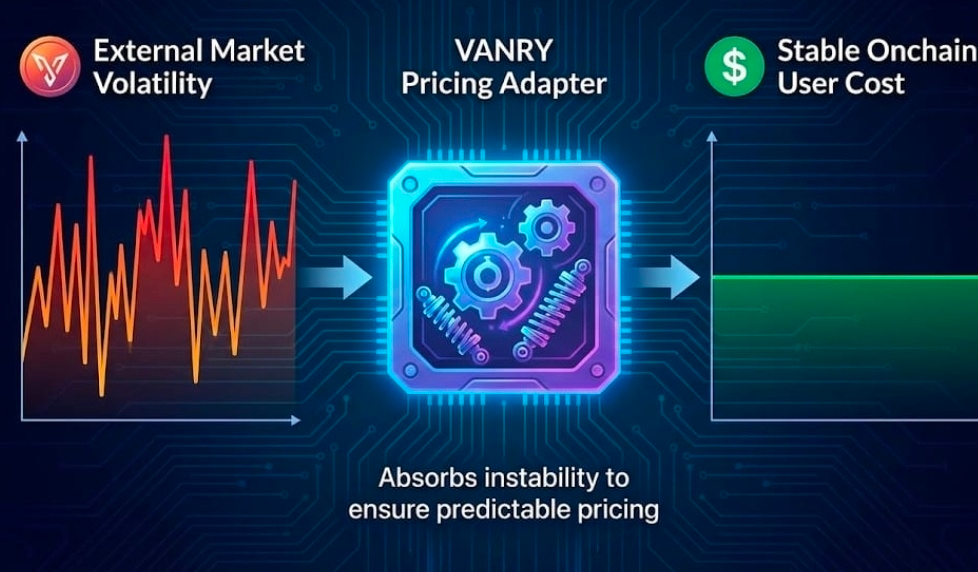
So Vanar targets something more boring, more practical, and frankly more powerful: a consistent, fiat-equivalent cost for common transactions. Not “always the same amount of VANRY,” but the same felt price for the user journey. The chain recalculates the VANRY amount as the market price changes, so the person using an app isn’t forced to ride the token’s volatility like a rollercoaster.
That’s where the token becomes more than a fuel label. VANRY isn’t just “the coin you pay gas with.” In this model, it plays a quieter role: it absorbs the instability of the external market so the onchain experience can stay stable. VANRY becomes the adapter between speculative pricing outside and predictable product pricing inside. If Vanar succeeds, the best compliment it can receive is that users barely notice the token while still benefiting from what it enables.
But fixed fees aren’t magic. If everything is permanently cheap, you invite spam, abuse, and waste. Vanar’s approach acknowledges that by using fee tiers—keeping the everyday path extremely low-cost while pricing heavy, unusual, or abusive transactions higher. That structure matters because mainstream scale isn’t just about being cheap; it’s about being cheap without being fragile. When the network can defend itself without punishing normal usage, it gets to stay friendly under pressure. And staying friendly under pressure is the difference between a chain that demos well and a chain that survives real demand.
EVM compatibility also fits this story in a very human way: developers don’t want to relearn the world every time they build. If you’re trying to attract builders who ship real products, you meet them where they are—tooling, languages, patterns, infrastructure. Vanar leaning into EVM means the fixed-fee promise isn’t trapped in a niche environment. It’s positioned as a practical alternative for teams who already know how to build, but want a place where fees don’t sabotage onboarding and retention.
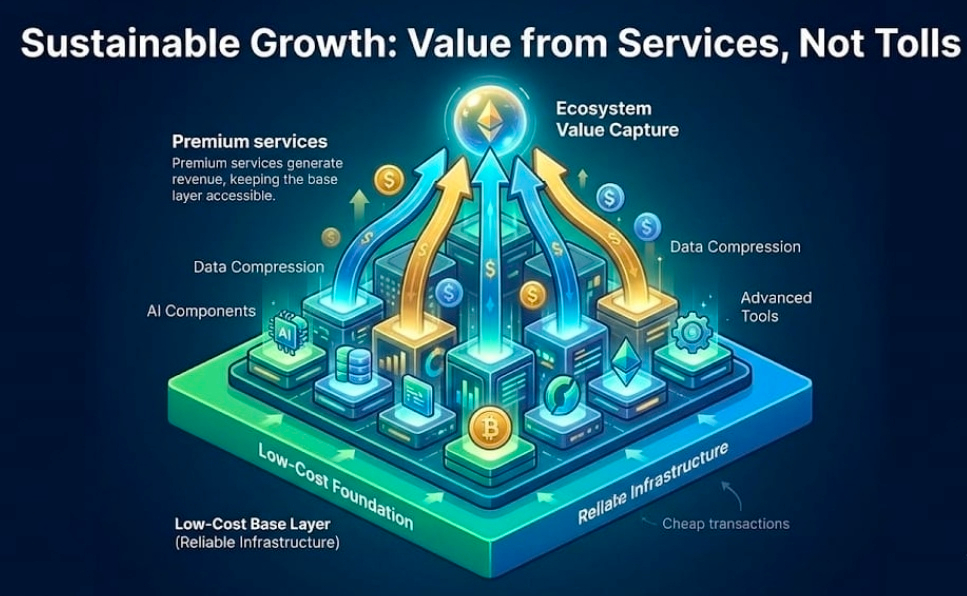
Now zoom out a little. Fixed fees at microtransaction levels compress revenue per transaction. That creates a pressure point: how does the network sustain itself and how does VANRY capture value if the base layer is intentionally inexpensive? This is exactly why Vanar’s broader direction matters—especially the push toward higher-layer products and service-like primitives (such as compression and AI-oriented components). The idea is simple: the base layer should feel like reliable infrastructure, and the value capture should expand into services that people pay for because they’re genuinely useful—not because they’re forced to pay unpredictable tolls.
That’s the bet. And it’s not a small bet.
Because the hardest challenge isn’t building “fixed fees” once. The hardest challenge is defending the promise across volatility events, growth spikes, and governance decisions. How often does the fee target update? What happens when markets move violently? How does the network avoid underpricing block space while still protecting the mainstream user experience? These aren’t marketing questions. They’re design questions that reveal whether the chain is engineered for adulthood.
If Vanar gets this right, the impact isn’t just cheaper transactions. The impact is psychological. People stop treating onchain actions like special events. They stop pausing to calculate. They start behaving naturally—because the system finally behaves predictably. And in that world, VANRY becomes what most tokens never truly become: not a coin people buy to speculate on, but an instrument that quietly holds the pricing contract together, transaction after transaction, at the scale where mainstream usage actually lives.
That’s the real point: fixed fees aren’t about being the lowest-cost chain on a good day. They’re about being the most trustworthy chain on a busy day.
