

What stuck with me wasn’t a benchmark or a screenshot of stats—it was a tiny reflex.
I clicked… and then my hand hesitated like it wanted to click again. Not because I was testing anything, not because I was trying to be clever—just because that’s what people do when an app leaves even a sliver of doubt. That half-second where you’re thinking, did it register or didn’t it? is where the “blockchain experience” actually lives. Not in a TPS claim. Not in a chart. In that quiet, human pause.
That’s why Fogo doesn’t read like a chain trying to win a public scoreboard. It reads like a chain built by people who’ve watched enough users bounce off an on-chain product to understand what really breaks retention. Most networks can be fast once. Most networks can look clean in ideal conditions. What’s rare is consistent, boring smoothness—the kind that makes confirmations stop feeling like a separate ritual and start feeling like a normal app response. The moment you cross that “instant-feel” line, behavior changes. The user stops managing the chain, and starts simply using the product.
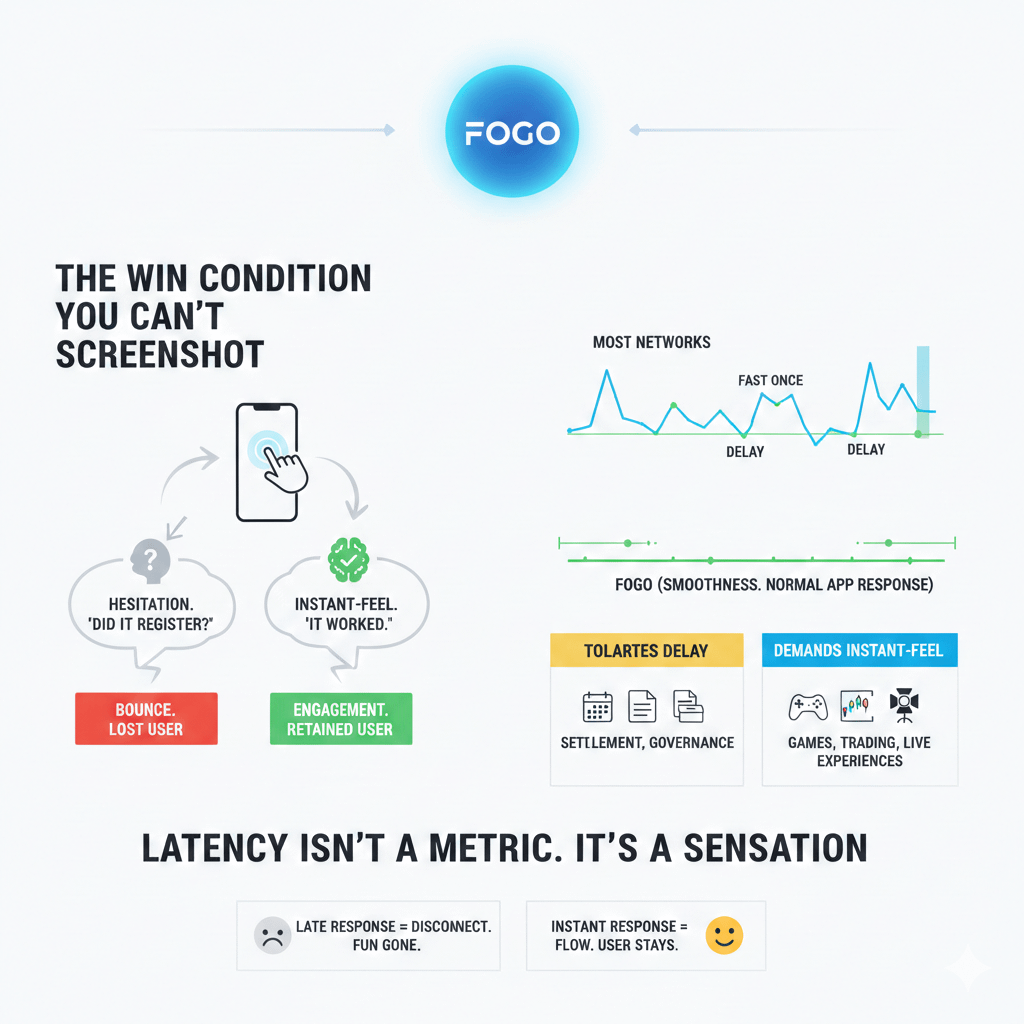
And here’s the part people miss: not every application needs that. Some things can tolerate a little delay. A slow settlement flow won’t ruin someone’s day. A governance action can afford a breath. But anything interactive—games, trading, live experiences, the kinds of products built on rhythm—has a different standard. Latency isn’t a technical metric there. It’s a sensation. If the response arrives late, the brain doesn’t politely wait. It disconnects. The fun disappears. The confidence breaks. The user leaves.
Fogo is interesting because it’s making a very specific bet about that world. It’s an SVM Layer 1, anchored in the Solana Virtual Machine approach, and that’s not a cosmetic choice. That’s a shipping choice. It’s a way of saying: developers already have habits, programs, tooling, and muscle memory here—let’s not waste years re-teaching everyone how to build. Keep the surface area familiar, then spend the real effort where it matters: in the parts that decide whether an on-chain app feels like a smooth application or a series of interruptions.
What caught my attention isn’t “we’re fast.” It’s how the design keeps returning to the same idea: smoothness only happens when the system behaves well under normal, messy life. Real traffic. Real geography. Real wallets. Real users on phones. The world where things don’t happen in perfect conditions.
Fogo leans into performance at the client and network level in a way that feels almost unromantic. It acknowledges that if your baseline is defined by the slowest meaningful slice of your validator set, you’re never going to get the consistency you’re promising. So the direction it points to—Firedancer, and the path through Frankendancer—reads like an insistence that the network should be able to run near physical limits, not average comfort. That’s not a marketing line. That’s an operational posture.
Then there’s the geographic reality that most people pretend doesn’t exist: distance. If consensus participants are spread out, you can’t argue with physics. Messages take time to travel. And that time shows up as jitter in the experience. Fogo’s answer is blunt: bring consensus closer together in zones to push latency down, then rotate zones across epochs so you don’t harden into one permanent geography. It’s a trade you can disagree with, but you can’t accuse it of being vague. It’s saying, “We want the fast path to be truly fast, and we’ll manage decentralization through rotation and governance instead of pretending proximity doesn’t matter.”
There’s also the uncomfortable truth about quality control. If you want a chain to feel smooth, you can’t ignore the operational side of who’s running it and how. Fogo talks about validator standards and curation in a way that’s clearly prioritizing reliability. That’s a controversial aesthetic in crypto, because it doesn’t sound as romantic as “anyone can join instantly,” but it aligns with the product goal. Smoothness is fragile. If a chunk of the network can’t keep up, users pay the price, and they pay it in the only currency that matters: attention.
But even if you got block production perfect, you can still lose the user at the wallet layer. This is the part that makes most “fast chains” feel slow anyway. The constant pop-ups. The approvals. The signatures. The tiny moments where the user has to stop being a user and become an operator. That interruption tax stacks up fast, especially in interactive experiences where flow is everything.
Fogo’s Sessions concept is aimed right at that. Account abstraction plus paymasters—gasless and no-approve flows—sounds technical on the surface, but the emotional purpose is simple: stop forcing people to perform rituals mid-experience. A user should be able to grant bounded permission with guardrails—spending limits, domain checks—then move through the product without being yanked out of the moment every thirty seconds. That’s how you get to “this feels like an app,” not “this feels like a chain.”
And I like that the developer story isn’t trying to be mystical. It’s practical. You build with familiar Solana-shaped tools, you point to Fogo endpoints, you use the plumbing you’d want in production—indexing, oracles, bridging, the boring infrastructure that makes shipping possible. Because none of this matters if the cost of building is still higher than the reward. Performance without adoption is just a better-looking graph.
Even the token disclosures, when you strip away the noise, matter only insofar as they protect the same thesis over time. If the identity is execution and real-world usability, incentives eventually have to defend that. Otherwise the system drifts. Chains don’t usually fail because the code is bad; they fail because the environment stops rewarding the thing they were designed to be good at.
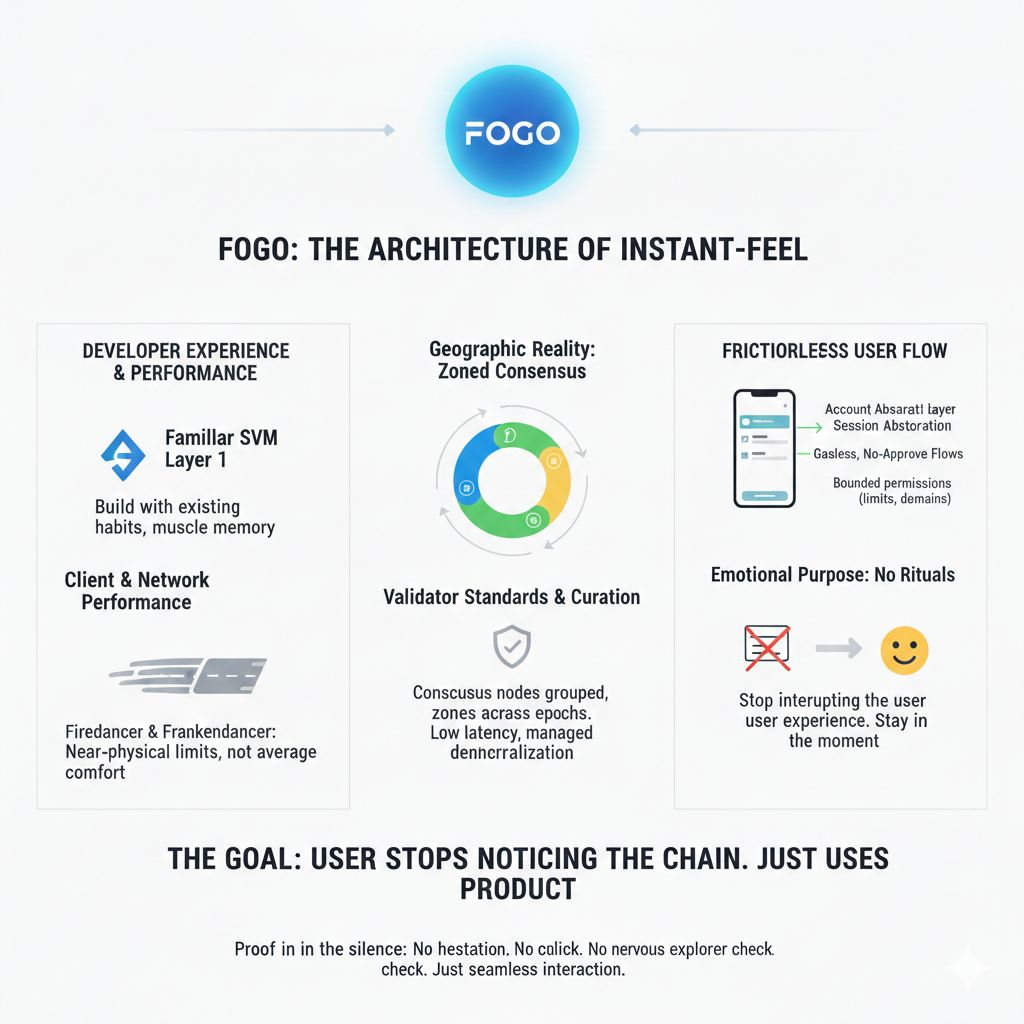
So when I say “Fogo targets smooth,” I’m not trying to romanticize it. I’m describing something very specific: the pursuit of a world where users stop noticing the chain at all. Where confirmations no longer feel like a separate ceremony. Where a game doesn’t lose its rhythm. Where an interactive app doesn’t train people to hesitate. Where builders can ship without dragging users through a maze of friction just to do something simple.
And if it works, the proof won’t be in the way people talk about it on crypto Twitter. The proof will be quieter than that. It’ll be in the moment someone uses an on-chain product powered by Fogo and doesn’t do what I did—doesn’t hover their finger, doesn’t click twice, doesn’t open an explorer like a nervous habit—because their brain never asked the question in the first place. That’s the only kind of “fast” I really trust now: the kind you don’t have to think about.
